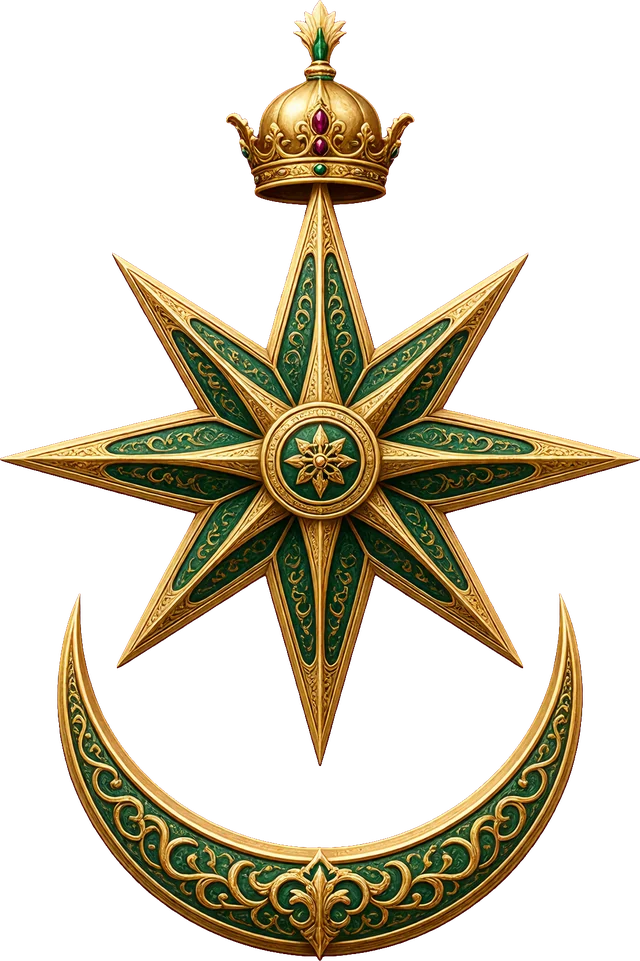
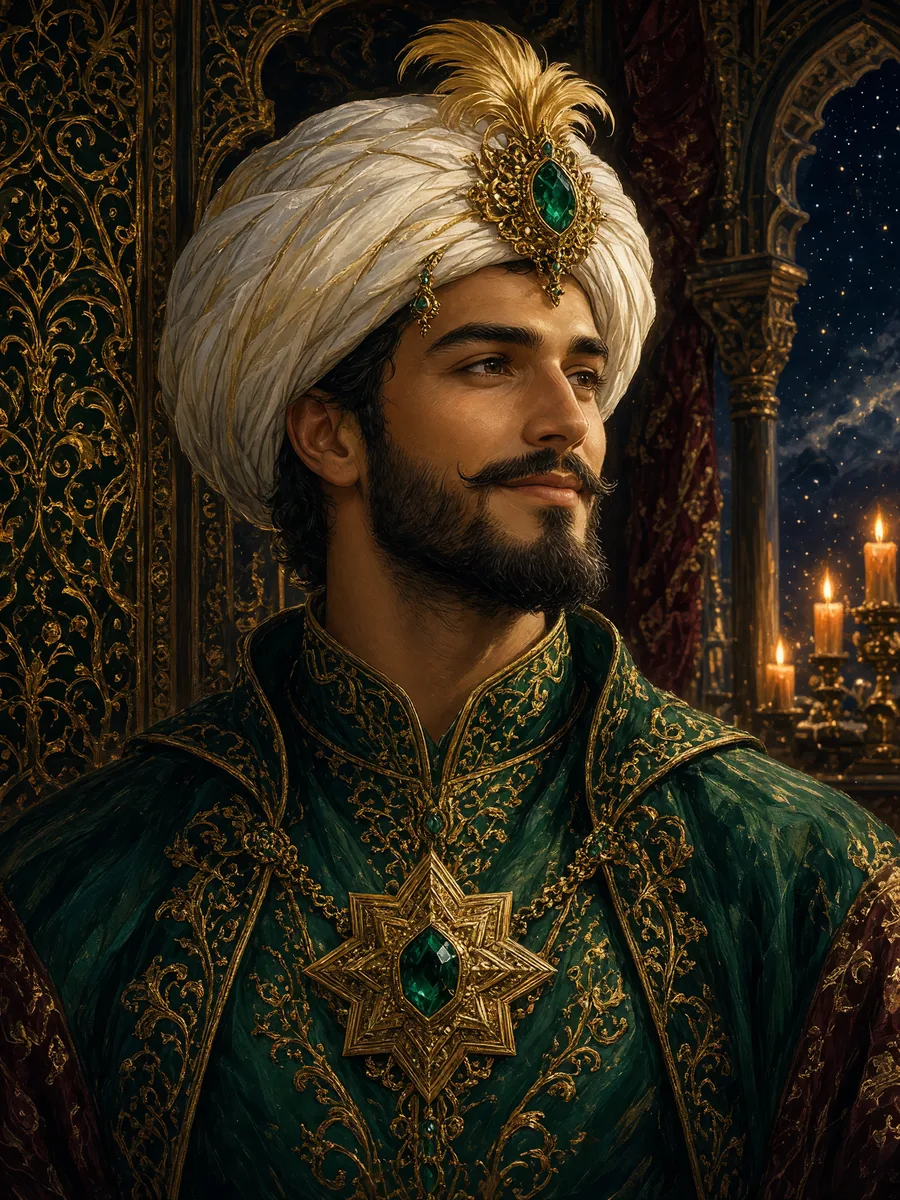
The northern lord who found the Star Stone, had it carved, and built a palace from it. Today, the Sultan who welcomes guests in the lobby.
- Origin
- A small principality in the north; only son of Kara Toğrul
- Emblem
- The emerald in his turban (the tear of Zümrüdüanka) and a golden feather
- Companions
- Asena (the gray wolf), Akyel (the winged tulpar)
- Consort
- Nilüfer Sultan
- In the palace
- The host in the lobby who says, "Welcome to the palace, your table is ready"
Not everyone yet. There are more still to come.
Who he is
Aybars takes his name from his grandmother: "let him be bright as the moon, brave as the leopard." But at the start of the story he is neither bright nor brave; he is only lonely. His father, Kara Toğrul, is a lord once known for his hospitality who, after Erlik's whisper, came to eat alone in his hall of forty chairs. His father's words on his deathbed, "All my life I have gathered silence," shape the whole of Aybars's life.
He loves conversation more than the sword, and tales more than the hunt. He spent his childhood among cooks, grooms and guards; and so he knows people not by their titles but by their stories. His greatest strength is to invite the one across from him to the table. By talking to a tulpar in an ice cave, by sitting down across from a ruined merchant in a coffeehouse, by offering a chair even to Erlik in the middle of a storm.
His path in the story
After his father's death he flees into the mountains and, guided by Asena, finds the tear of the Iron Stake: the Star Stone. On the counsel of Umay Ana he sets out for Konstantiniyye; on the way he frees Akyel from the ice and shares his bread with Hızır. With Sina Hoca he learns the secret of the stone; from Şahmeran he receives the meaning of the four colors, from Zümrüdüanka the feather made of light. For forty nights he carves the stone, and one hundred and six tiles come forth.
He refuses Erlik's chest of gold: "No money turns at this table. The only thing won at this table is conversation." The stolen false okeys he wins back in the Grand Bazaar (Kapalıçarşı) not with a sword but by founding the first Kahvehane. With Nilüfer he makes Batak in a single night. In the Black Winter he fills the forty chairs of his father's hall once more, and at last he is crowned North Sultan: with a crown woven not of gold but of walnut branches.
In the palace
The last article of the palace custom is for him: The Sultan is the last to sit down. Even on the night of his coronation, before entering the hall, he goes to the great gate of the palace and looks outside; for he is thinking of those who have not yet arrived.
He is the Sultan in the lobby today, holding the scroll, smiling, with an emerald and a golden feather in his turban. The people believe he never died. Perhaps they are right; one who holds a door open lives on for as long as the door stays open.
A little-known detail
When Aybars fastened the emerald that Zümrüdüanka gave him to his turban, he also pinned upon it the golden thread that broke from the feather's light. The emerald chip set in the crown of the white king in the Chess Pavilion was taken from that very emerald. And so, in each of the palace's three games, somewhere, a piece of Aybars remains.
Appears in
- Chapter I A Light in the Snowy Mountains
- Chapter II The White Swan
- Chapter III The Tulpar in the Ice
- Chapter IV In the Shadow of the Dome
- Chapter V The Four Colors of Şahmeran
- Chapter VI The Emerald Feather of Mount Kaf
- Chapter VII One Hundred and Six Tiles
- Chapter VIII Erlik's Bargain
- Chapter IX Lost Stones in the Grand Bazaar
- Chapter X The Paper Palace
- Chapter XI Sixty-Four Squares
- Chapter XII The Black Winter
- Chapter XIII The Door That Never Closes
- Epilogue An Empty Chair at the Table