
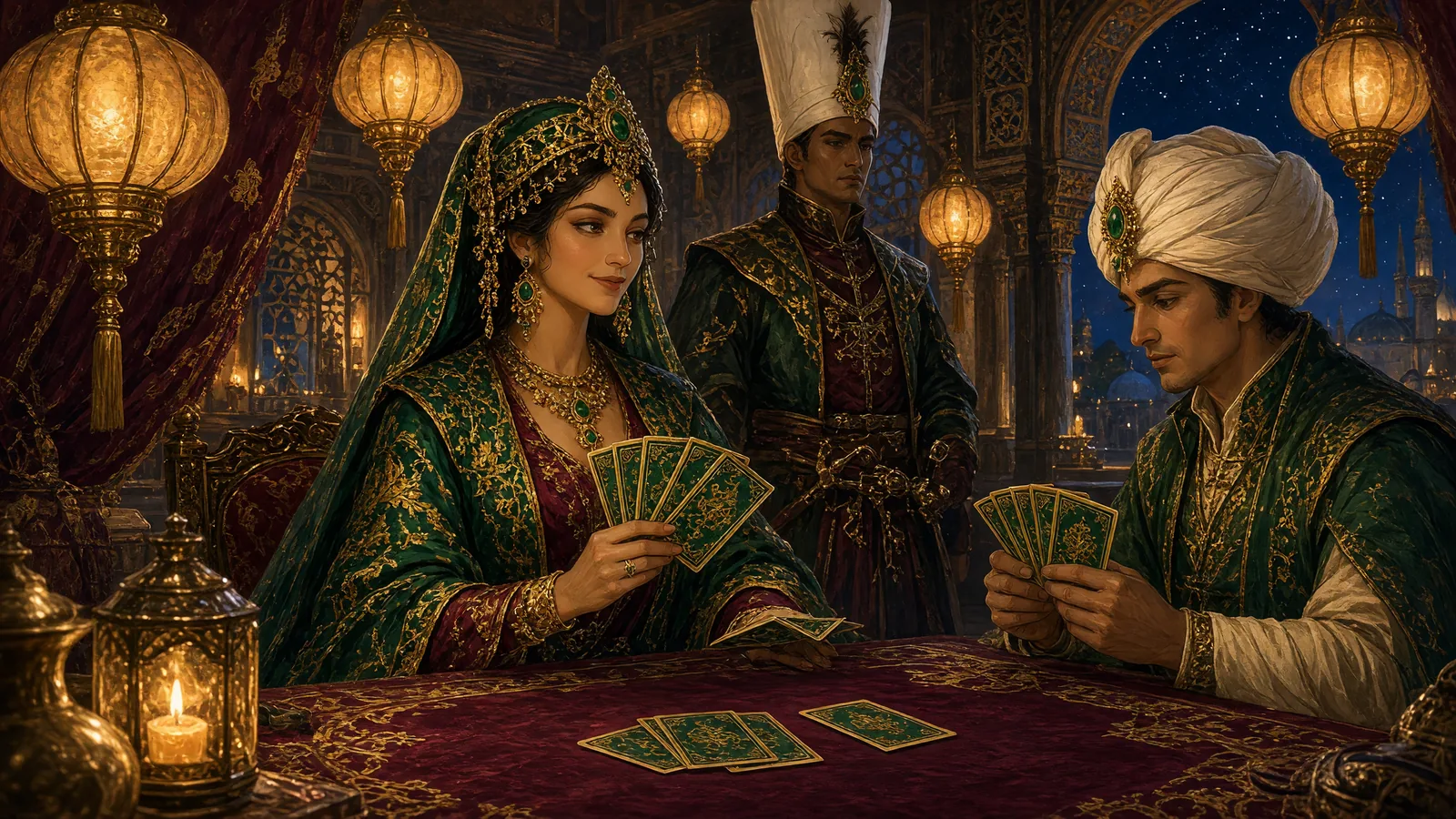
At the farthest end of the Golden Horn, where two streams wander into the city, there lay a valley called Kâğıthane — the Paper Mills. The valley took its name from the paper mills that once worked there. The streams turned the mills, the mills pounded scraps of linen, and from that pulp the masters drew sheets of paper thin, white and fine as silk. Every book in Konstantiniyye, every decree, every love letter was written on paper that came from those mills.
Above the valley, among the willows and the tulips, stood a pavilion. Everyone called it the Paper Palace. For every window of the pavilion was covered not with glass but with paper, every lantern was made of paper, and in its rooms hung hundreds of paintings on paper. The mistress of the pavilion was Nilüfer Sultan.
Whose daughter Nilüfer was, and where she had come from, no one quite knew. Some said she was the last princess of a sultanate in the east; others, the only daughter of a rich paper merchant. She never answered such questions herself; she only smiled. She was about twenty. She was beautiful; but those in the city who knew her spoke of her mind before her beauty. She spoke six languages, knew four books of reckoning by heart, and had never lost at chess to any pasha. And she drew cards.
The Cards
Nilüfer's cards were a legend in the city. Cut from thick, stiff paper, each one the size of a hand, with emerald-green and gold arabesques on their backs. On their faces were four signs: spades, hearts, diamonds, clubs. Thirteen cards of each sign. Numbers from two to ten, then three figures of the court: the jack, the queen, the king. And above them all, mightier than any, the ace.
Nilüfer drew the court figures herself. The kings resembled Ottoman sultans, the queens ladies of the palace, the jacks young janissaries. And if you looked carefully, you would see Nilüfer's own eyes in the face of every queen; and in the face of every jack, the young janissary who stood guard at the pavilion's gate.
That janissary's name was Doğan. He was nineteen, tall, quiet, a youth in a white börk. He had been sent to guard Nilüfer's pavilion — but in truth, he had volunteered. No one had asked him why. Nor had Doğan told. But when Nilüfer's laughter spilled from a window while he stood at the gate, the very faint smile on his face said everything.
Nilüfer had one sorrow: her cards were very beautiful, but the games played with them bored her. Games of chance — draw a card, the higher one wins. Or, worse still, games played for money. It angered her to see her cards so often in such games in the mansions of the city. "They use my cards like dice," she would say. "I drew faces for them, I gave them souls. And they count money with them."
And then one day, word came from the Kahvehane. That a young man from the north had set up a table where no money passed hands, that he had shut Erlik's gaming house with a tea stove, and that he had people playing such a game with ivory stones that half the city spent its evenings at those tables.
Nilüfer grew curious. And Nilüfer, once curious, did not wait.
The Invitation
One morning a letter came to Sina Hoca's door. Written on the finest paper of Kâğıthane, in purple ink, unsealed. Hasan Efendi read it, then handed it to Aybars:
Lord of the North,
I hear you sit people down at a table with your stones. Good. I have my papers. Let us see which speaks more: your stones, or my papers?
Tonight, at the Paper Palace. Bring three with you. I will be waiting with three. The loser shall teach the winner's game for one whole year.
Nilüfer
"The loser?" said Hasan Efendi, raising his eyebrows. "But at our table nobody loses."
"At hers, it seems, somebody does," said Sina Hoca with a smile. "Go, Aybars. But be careful. They say that girl has beaten even me at chess."
"Have you ever played her?"
For a moment the master's face reddened. "Once. So they say."
A Night at the Paper Palace
That evening Aybars took with him Hasan Efendi, Rıza Bey and Kahveci Mustafa. Sina Hoca did not come. "One does not play with an old man's pride," he said. Asena waited in the pavilion's garden among the tulips. Akyel waited beneath the willows.
Inside, the pavilion was as lovely as it looked from without. Paper lanterns hung from the ceiling, each one burning in a different color. On the walls, paper birds, paper flowers, paper stars. And in the middle of the room, a table draped in burgundy velvet.
Nilüfer sat at the head of the table. A gown of burgundy and gold, and on her head a hotoz embroidered with emeralds. Beside her, three companions: Doğan, an old paper-maker, and a dignified lady who was steward of the pavilion. When Nilüfer saw Aybars she did not rise. She only looked at him. Long and steadily. Aybars had believed that after the gaze of the Zümrüdüanka, no one's gaze could move him. He was wrong.
"Where are your stones?" said Nilüfer.
"The master set stays on Sina Hoca's table. Tonight let us play with your cards."
"My games are boring," said Nilüfer. "You draw a card, the higher one wins."
"Then," said Aybars, settling onto the velvet, "let us make a new game."
The Bid
It lasted all night.
First they dealt the cards. Thirteen to each player. Four players, fifty-two cards. Nilüfer's old game went like this: everyone plays a card, and the highest takes the trick. Thirteen tricks are played, and whoever takes the most tricks wins. Simple. And, as Nilüfer said, dull. For whether the cards came good was not in your hands.
After one hand, Aybars stopped.
"Something is missing," he said.
"What is missing?"
"A promise." Aybars closed his cards. "When we play with the stones, every stone means something. But in this game the cards are only high or low. No one pledges anything. What if, before each hand began, every player said how many tricks they would take? Looked at their own cards and said, 'In this hand I'll take four tricks'? And if they kept their word they won, and if they couldn't, they lost?"
Nilüfer's eyes lit up. "And the one who gives the highest promise — what of them?"
Hasan Efendi broke in; as a scribe, he understood contracts. "They take the bid," he said. "Just as in the market. Whoever makes the highest offer takes the job. But if they cannot finish the job, they lose as much as they offered."
"And whoever takes the bid," said Nilüfer, thinking fast, "should be able to choose something. A privilege. Otherwise why would anyone make the highest promise?"
Doğan spoke for the first time all night. His voice was low and calm.
"Trump, my Sultana."
Everyone turned to him.
"In war," said Doğan, "every army has its trump. A weapon, a stratagem, a secret. When you play your trump, you beat everything else. But if you waste your trump, you are left with nothing in your hands. Let whoever takes the bid choose a suit. Let that suit be trump. And let trump beat every other suit."
Nilüfer gave him such a look that Doğan's ears turned red.
"And the one who can't keep his word?" said Rıza Bey. "Who says four tricks and takes two?"
Kahveci Mustafa twirled his mustache and laughed. "He sinks, sir. Like a ship. Whoever doesn't keep his word, sinks."
A roar of laughter broke over the table. And the name was given there and then. Batak — from batmak, "to sink." The game in which whoever breaks their word goes under.
Rules Through the Night
Then, one by one, the rules fell into place. You had to follow the suit on the table; if you held that suit, you must play it. If not, you must play trump. And if you had no trump either, then whatever you liked. That way no one could hide their cards and spring a surprise later; the game would be honest. Nilüfer laid down this rule herself, and gave her reason thus: "Whoever hides their card at a table hides their word as well."
Then, at Rıza Bey's suggestion, they tried a version where trump was always spades. There was still a bid, but no choosing of trump; spades were always the strongest. They called it Spades Trump — Koz Maça. It was a faster, sharper game; Mustafa liked it very much.
And in the last hours of the night, Nilüfer proposed one thing more. "Instead of four people playing each for themselves," she said, "what if two people made a team? Two people sitting across from each other. A trick taken by one would count for the other too. The promise of one would bind the other."
"Partners," said Hasan Efendi, writing in his ledger. "Eşli."
"Partners," said Nilüfer. And then she did something no one expected: she turned to Aybars and said, "You be my partner. For this hand."
A silence fell over the room. Something stirred on Doğan's face and was gone at once. Aybars moved to the seat across from Nilüfer.
That hand was the longest of the night. Nilüfer bid seven. Aybars held no good cards. But for Nilüfer to keep her word, the two of them together had to take seven tricks. As he played each card, Aybars looked into Nilüfer's eyes. As she played each card, Nilüfer looked at Aybars's hands. They did not speak. Speaking was forbidden. But on the last trick, on the very last card, Nilüfer played the ace of spades, and Aybars, as though he had been waiting for it, laid down the only trump he held, the two of spades, in support.
Seven tricks. The promise was kept.
Nilüfer laughed. The paper lanterns swayed.
Who Won
When morning came, no one remembered who had won. Hasan Efendi looked in his ledger and set about reckoning it up, but Nilüfer stopped him.
"I lost," she said.
"How do you mean?"
"I wrote it in the letter. The loser teaches the winner's game for a year. I want to learn your game, Aybars. Your stones. Okey. One hundred and one." She gathered up the cards and showed Aybars the back of the deck. "And you learn this. Batak. We made it together tonight. No one lost."
Aybars looked at the emerald and gold pattern on the back of the deck. It looked like the feathers of the Zümrüdüanka.
"A year is too little," he said.
"Then," said Nilüfer, "a lifetime."
Doğan stood by the door. His face showed nothing. But when Aybars looked at him, he saw something in the young janissary's eyes: a loss, and an acceptance. Aybars went to him.
"Doğan Ağa," he said. "Tonight you found the trump. Half this game is yours."
Doğan bowed his head. "I am a soldier, my lord. Games are not my business."
"There are no soldiers at the table," said Aybars. "There are partners. Come, play a hand with me. Across from each other."
Doğan hesitated a moment. Then he looked at Nilüfer. Nilüfer nodded. And the young janissary, for the first time in his life, left his sword beside the door and sat down at the table.
That hand Aybars and Doğan were partners, against Nilüfer and Rıza Bey. Whether they won or lost, no one remembers. But what began that night was a brotherhood. Doğan would one day come north and guard the palace gates — not to keep them shut, but to keep them open.
Faces of Paper
That week Nilüfer drew a new deck. To the kings, for the first time, she gave a face: a northern face, young and smiling, with an emerald in its turban. To the queens she gave not her own eyes but her whole face. The jacks were Doğan once more — but this time, he was smiling.
Today, when you see a king, a queen and a jack at the Batak table in the palace of the north, you know whose faces they are.
That night Erlik sat on the roof of the Paper Palace in the shape of a raven and watched it all. Inside, no one counted money. No one lost. Four people made a game, and the game bound them to one another. As Erlik spread his wings and flew off, he ground his teeth. After the stones, the cards too had slipped from his grasp.
One thing remained. A game with no room at all for chance. No dice, no drawing of cards, no surprise stone. Only mind, patience and waiting. Erlik knew that game very well. He had been playing it for centuries. And no one had ever beaten him.