
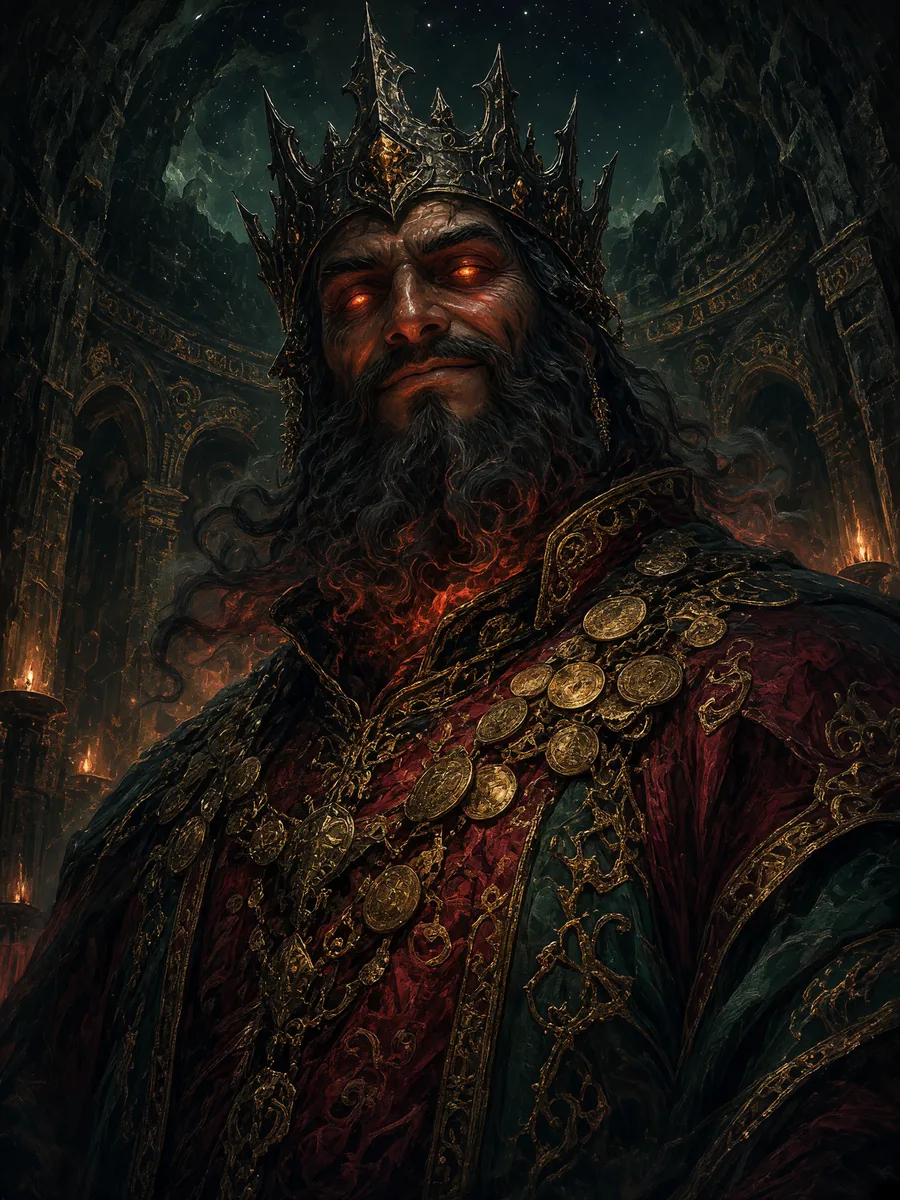
Born of the same breath as Ülgen, he is the khan who chose darkness and silence. He wants to bind the tables to money and people to loneliness. The enemy of our story; yet by its end, perhaps, one who learns to be a guest.
- Home
- The depths of the earth, a palace of black basalt
- Weapon
- Not a sword; the greed to win and the whisper of loneliness
- Servants
- Shadows, crows, Kara Kuzgun the Black Raven
- Emblem
- A black iron crown; the smell of a dead hearth's ash
- Mythological roots
- Ruler of the underworld in Turkic mythology
I do not know how to be a guest. I know how to take. Not how to give.
In Mythology
In the old Turkic tales, Erlik is the ruler of the world beneath the earth. He is the opposite of Ülgen, the good god of the sky, and in some tellings his brother. He governs the souls of the dead and sends forth the beings that bring harm to people. Black colors, iron and darkness are bound up with his name.
In Our Story
The Erlik of this story does not come with a sword; for a sword brings people together, and they stand shoulder to shoulder against the enemy. He comes with something far more cunning: "Your neighbor's cauldron is bigger than yours. Why should you share your soup with him?" His whisper closes the doors one by one, and turns games into things played not for laughter but for winning. It is he who made the Iron Stake weep.
First he sends his shadow, then he comes himself. He enters the room beneath Sina Hoca's roof in the guise of a handsome buyer and sets a chest of gold upon the table. He has only one condition: that the tiles be played for money. When Aybars refuses, he steals Hızır's two tiles; but in his gambling den the tiles lie empty and useless, for their work is not to make anyone win but to make things whole. From the roof of the Paper Palace, in the shape of a raven, he watches Batak being born. He loses to Sissa Dede at chess; he is fast, he is strong, he takes many pieces, but he never once thinks of his own king.
His last blow is the Black Winter: a winter in which he makes not snow fall, but loneliness. Yet when hundreds of tables are set up in the square, his face fades in the sky. When Aybars invites him to the empty chair, for the first time he is not defeated, but for the first time he stops.
Afterwards
The old folk say that Erlik is still in the depths of the earth, and still alone. But sometimes, at one of the most out-of-the-way tables in the palace, a silent player dressed in black appears. Most of the time he loses. He does not get up. He plays one more hand. And when he leaves, he carefully pushes his chair back in to the table, for the next player.
The second article of the palace custom, "No money changes hands at the tables of this palace," was written against him. But the fourth article, "At every table there is one empty chair," was perhaps written for him.