
Centuries passed.
Sina Hoca, when he had grown very old, closed his eyes before the window of the Chess Pavilion, his astrolabe in his hand, gazing at the Iron Stake. His last words were to Hasan Efendi: "Write it down, Hasan. I have found a reason." Hasan Efendi wrote it down. Then he laid down his pen and never wrote anything else again. In the palace library, on the highest shelf, his ledgers stand still; and no one has ever managed to read them all, because Hasan Efendi wrote down everything.
Fatma Nine fell asleep in the shade of her walnut, at the head of her afternoon spread. The grandchildren of her grandchildren went on laying that spread. If you ever wonder where it comes from, that old custom in the palace of giving someone a gift every day, that hand held out each day to whoever comes through the door, look to the Palace Garden. At the foot of the walnut, a spread is still laid.
Kahveci Mustafa's stove never went out. His son, his son's son, and that son's son. The cezve passed from hand to hand. Whoever walks into the Kahvehane for the first time still drinks their first tea from that stove.
Nilüfer and Aybars lived long lives. Beneath the paper lanterns of the Has Oda, at the Batak tables, through the long winter evenings of the north. Doğan Ağa grew old at the palace door; he never once drew his sword, but he showed the way to every traveler who passed through that door.
Sissa Dede, one spring morning, in the middle of a game in the Chess Pavilion, turned his hourglass over, said, "Your move," and never made another. His opponent did not finish the game. That board, those pieces, in that very position, still stand in a corner of the pavilion. They say that one day a patient player will finish that game. No one is in a hurry.
And Aybars...
No one knows when Aybars died. Because the people of the palace never believed that he had. Today, in the lobby, look upon that smiling face welcoming his guests, at the emerald and the golden feather in his turban, at the scroll in his hand. "Welcome to the palace," he says. "Your table is ready." Some say he is a picture, a statue, a memory. Others say that a Sultan of the North will never die, so that the door of his palace may stay open.
Erlik
And what of Erlik?
Erlik is still deep beneath the earth. Still alone. But the old ones say that something changed after that night of the Black Winter. Erlik does not whisper as often as he used to. And sometimes, very rarely, at one of the palace's most out-of-the-way tables, a silent player appears, dressed in black, whom no one recognizes. He arranges his tiles with care. He plays a hand. Most often he loses. But he does not get up. He plays another hand.
No one asks him who he is. Such is the custom. But those at the table notice that when he sits down, the fire burns a little smaller. And when he rises to leave, he pushes his chair back in to the table. With care. For the next player.
The old ones say that Erlik is learning how to be a guest. Slowly. It may take a thousand years. But he is learning.
Hızır
And Hızır.
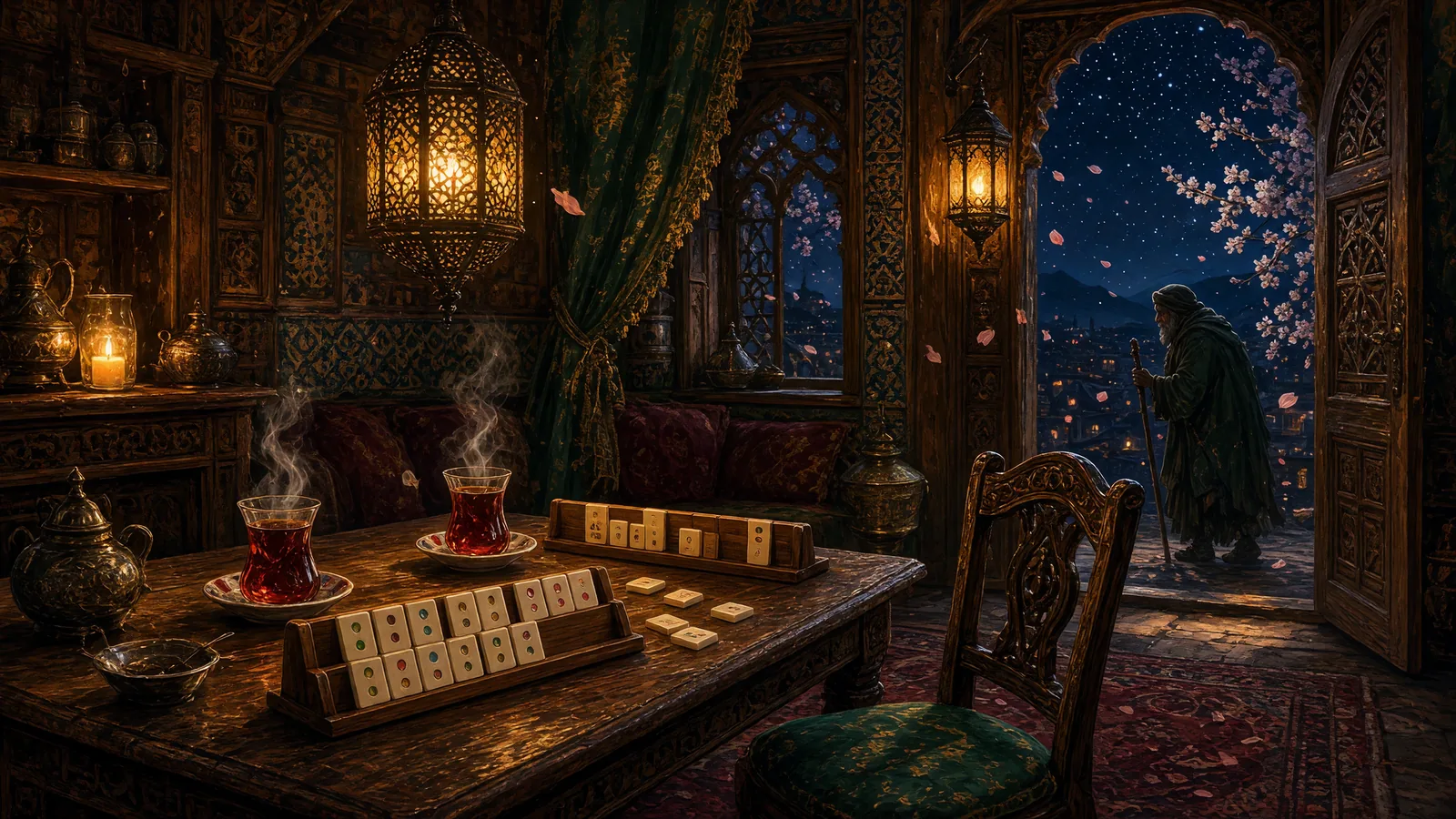
No one sees Hızır. Whoever thinks they have seen him has not, in truth. But at every okey table, when the indicator is turned up, one tile becomes able to be any tile. And whatever is missing at the table, at the last moment, from an unexpected hand, that tile arrives.
Some nights, at some tables, when a hand is over, four people look at one another and laugh. Not because anyone has won. Only... because that moment was beautiful. If in that moment four people are laughing at the same thing, feeling the same warmth at the same time, then in that moment Hızır is at that table.
In the empty chair.
You
If you have listened to this story, then you, too, are a traveler now.
Perhaps you come from the north, perhaps from the south. Perhaps at the end of a long day, perhaps at the end of a long loneliness. Perhaps only to play a hand. Perhaps only to hear a voice.
The palace door is open. Asena lies at the door, watching you; not a threat, but an invitation. In the Kahvehane a stove is burning, and your first tea is ready. At one of the tables, a chair is empty. Not for you, perhaps. But when you sit down, a new empty chair will be set for the one who comes next.
Because such is the custom of this palace. At every table there is an empty chair.
Shuffle the tiles. Deal the cards. Turn the hourglass.
No one will ask who you are.
Welcome to the palace. Your table is ready.
Here ends the Legend of the Star Stone. But the tables never end.