
When spring came, just as they had promised, Rıza Bey and Mehmet Paşa arrived in the north. With them they had brought a whole caravan of craftsmen from Konstantiniyye: an army of carpenters, stonemasons and tile-makers. Mehmet Paşa truly had left his sword at the door. Rıza Bey, for his part, pointed to the camel at the very back of the caravan; on its back were a hundred carpets he had brought from the Carpet-Sellers' Bazaar.
"I hear you're building a palace," he said. "And what is a palace without carpets?"
Aybars met them in the village square. The tables in the square were still set up; the villagers had not counted the end of winter as any reason to clear them away. Mehmet Paşa looked around him and raised his eyebrows.
"This village," he said, "has grown more crowded than Konstantiniyye."
The plan of the palace
Sina Hoca drew the plan of the palace himself. But each hall he drew together with the one who would be its keeper.
"A palace," said the Hoca, spreading a great sheet of paper across Kara Toğrul's table, "is not a fortress of stone. A fortress shuts its gates; a palace opens them. At the heart of this palace there will be a courtyard, and at the heart of the courtyard, Fatma Nine's walnut. Every door that opens onto the courtyard will be a hall. And no door will have a lock."
"Without locks, thieves will come in," said Mehmet Paşa, as a man of law and order.
"Let them," said the Hoca. "Let them come in and sit down. A thief who sits at a table stops being a thief one hand later. You saw it yourself in the Kahvehane."
The Paşa thought about it, then laughed. "I saw it."
The halls
The palace took seven years to build. For all seven years the tables were never cleared away; the craftsmen worked by day and played by night. People came from every corner to help. Those who laid stone upon stone, those who brewed the tea, and those who threw down their okey at the table in the evening were the very same people.
And every hall bore the name of a friend.
The Kahvehane was the first to be built. At the entrance of the palace, the place where a newcomer takes their first step. Kahveci Mustafa's stove was set up there. On its walls they hung the first sign from the Grand Bazaar: Here no one loses. Mustafa had only one rule: everyone who walks through the door for the first time, whoever they may be, drinks their first tea from Mustafa's own hand. This is the table for beginners: small, warm, patient.
The Grand Bazaar became the second hall. Rıza Bey's hall. Its ceiling vaulted, its lanterns of colored glass, its carpets from the finest looms in the bazaar. The hall of shopkeepers, of merchants, of lively tables. Every evening Rıza Bey would stand at the door and say the same thing to every stranger waiting there: "Come, brother. We're looking for a fourth."
The Palace Garden became Fatma Nine's. In one corner of the courtyard, where the walnut's shade would fall as it grew. Rose bushes, lanterns, fountains. Fatma Nine's table was always there; every afternoon she would lay a spread and call to whoever passed by. At night, when the lanterns were lit, the garden looked from afar like a cluster of stars.
The Has Oda was Nilüfer's hall. Paper lanterns brought from the Paper Palace, velvet curtains, poems written in violet ink. There Nilüfer laid down her own rules: in the Has Oda, the ladies' word is always heard first; and everyone who sits at a table for the first time, however badly they are beaten, receives at the end one of her cards as a gift from Nilüfer's own hand. A warm, hidden corner set aside for the palace's most honored guests and its most faithful friends.
The Divan-ı Hümayun became Mehmet Paşa's. The largest, most splendid hall of the palace. In the Paşa's own words, "the place where great words are spoken and great hands are played." Imperial monograms on the walls, a dome of gold leaf overhead. Yet for all its grandeur, the door of the Divan was never locked either. The Paşa had only one rule: whoever enters the Divan leaves his sword at the door. Here it is the word that speaks, not the sword.
These were the halls of 101. But as the palace grew, so did the number of its halls.
The Batak hall and the paper birds
Nilüfer and Doğan asked for a wing of its own for the Batak tables. Paper lanterns, cloths of burgundy velvet, and above every table a paper bird. With Nilüfer's rules: a word is given, and a word is kept. Whoever cannot keep it goes under, but no one looks down on the one who goes under; at the next hand, everyone speaks their word anew. Doğan guarded the door of this wing, but not to shut it; rather, to show each newcomer who their partner would be.
The Chess Pavilion
Sissa Dede's chess set was placed in the quietest spot in the palace: beyond the courtyard, on the shore of the lake, an open pavilion from which the stars could be seen. Candlelight, wooden columns, and beside every table one of Sina Hoca's hourglasses. Over the pavilion's door, Sissa's words were written: Do not play like Erlik. Play like Sissa.
That spring Sissa Dede came north himself. He had said he could not bear the cold, but when he saw the pavilion, he stayed. "It isn't cold here," he said. "Here, people think. A place where people think grows warm."
The İznik tiled hall
One day Fatma Nine's grandchildren came from Konstantiniyye to visit her. They wanted to play okey. But 101 felt long to them: opening your hand, waiting for one hundred and one, adding up the numbers. The children were impatient.
"Isn't there a shorter one?" said the littlest.
Fatma Nine thought. Then, together with her grandchildren, she made a new game. No opening your hand. No one hundred and one. Everyone takes fourteen tiles, one player fifteen. Make your tiles into runs and sets, throw your last tile into the middle, and your hand is done. Quick, sweet, full of laughter. The indicator is still turned up, Hızır's tile still becomes any tile. And the one who finishes their hand first, laying their last tile on the pile, calls out "Okey!"
This game they called simply Okey. The merriest, most crowded tables in the palace became its own.
The craftsmen built a separate hall for this game. A hall faced with tiles brought from İznik, cobalt blue and turquoise, white, and red tulips. One of the patterns among the tiles, to whoever looked closely, resembled the green mark on an okey tile.
The crown
When the palace was finished, it was the last winter night of the seventh year. Lanterns were lit in every hall. The walnut tree in the courtyard had grown so much in seven years that its branches touched the palace roof.
That night the villagers, those who had come from Konstantiniyye, the caravan-men, the travelers, those who had sat in the forty chairs of the hall during the Black Winter, all gathered in the courtyard. And they asked for one thing.
The steward, a very old steward now, spoke for them:
"Son of the bey. This palace must have a sultan."
Aybars laughed. "I don't want to be a sultan. I never even wanted to be a bey."
"We know," said the steward. "That is why you must be."
Sina Hoca stepped forward. In his hands was a crown. But it was not made of gold. It was woven from the branches of the walnut tree, and at its center shone the tear of the Zümrüdüanka, the emerald from Aybars's turban. And the golden feather beside it was the very one that had been plucked on Mount Kaf seven years before.
"This crown has a condition," said Sina Hoca. "This crown gives you nothing, Aybars. It asks something of you. The doors of this palace will stay open. No money will change hands at the tables of this palace. No one in this palace will eat alone. The Sultan of this palace will be the last to sit down; only after everyone has found their place."
Aybars took the crown. He looked at it for a while. Then he set it on his head.
The courtyard filled with applause, with laughter, with Mustafa's cry of "The tea's on me!"
And in the very center of the sky, the Iron Stake burned with all eight of its points, brighter than ever.
That night the people gave Aybars a name. Because he had come from the north, because he had been born beneath the North Star, because he had built a palace in the north: Kuzey Sultanı, the Sultan of the North. Travelers from distant lands remembered him in their own tongues, and that name, in time, spread across the whole world: North Sultan.
The emblem
On the morning after the night of the crowning, Hasan Efendi drew the emblem of the palace. A crown, the crown woven for Aybars from walnut branches. Beneath the crown an eight-pointed star, the Iron Stake. Beneath the star a crescent, the crescent on Umay Ana's brow.
"The crown is the palace's," said Hasan Efendi, showing the drawing to Aybars. "The star is the road's. And the crescent is protection's."
Today you will see that emblem on the door of every hall, on the case of every set, on the edge of every table.
The custom of the palace
On the day the palace opened, Hasan Efendi wrote the custom of the palace into a great leather-bound volume. Aybars spoke it, Sina Hoca corrected it, Nilüfer shortened it, Fatma Nine added one article, Mustafa added another, and Hasan Efendi made the fair copy of it all. And the custom was set upon a stone pedestal at the foot of the walnut tree in the courtyard:
One. The doors of this palace are open night and day. No one asks who you are.
Two. No money changes hands at the tables of this palace. The only thing won at the table is good company.
Three. The palace tokens are only for keeping score at the table. They do not leave the palace, they are not sold to another, they are not exchanged for anything. They make no one rich, and they make no one poor.
Four. At every table there is an empty chair. It is for the guest.
Five. Whoever cannot keep their word goes under; but no one looks down on the one who goes under.
Six. The one who hurries loses, and so does the one who sleeps. The one who waits their turn wins.
Seven. Whoever walks through the door for the first time drinks their first tea from Mustafa.
Eight. A single key opens every hall of this palace. Once that key is given, it belongs to its holder; from the Kahvehane to the Divan, from Batak to the Chess Pavilion, every door opens to them.
Nine. The Sultan is the last to sit down.
The article Fatma Nine added was the seventh, yet it was Mustafa's name it carried. The article Mustafa added was the fourth, yet it had been Fatma Nine's idea. None of them saw any need to set it right.
Those who did not come, and those who did
On the night of the crowning, three things passed over the palace.
The first was a white swan. It circled once above the courtyard, one of its feathers caught in the branches of the walnut tree, and then it flew off toward the Iron Stake. Fatma Nine took that feather and gave it to the palace midwives, to be hung above the cradles.
The second was a giant bird, emerald and gold. No one saw it clearly; it passed like a shadow, like a cloud. But after it, from the sky, three small golden feathers fell. Onto the roof of the Chess Pavilion, onto the window of the Has Oda, and onto the door of the Kahvehane.
The third did not pass over. In the darkest hour of the night, unseen by anyone, a tiny golden snake slipped to the foot of the walnut tree in the courtyard. It bit its own tail and became a ring, and settled among the roots of the tree. That night all the snakes of the palace, if there were any, slept. And the thing Şahmeran had once asked for came to pass: a place had been made for her, too, at a table. As deep as the roots, but at the foot of a table all the same.
In one corner of the courtyard, at a table where no one sat, an old man in a green cloak held a glass of tea in his hand and smiled upon the crowd. When someone rose to discard an okey to him, the chair was empty. On the table, only a single white flower remained.
The door that never closes
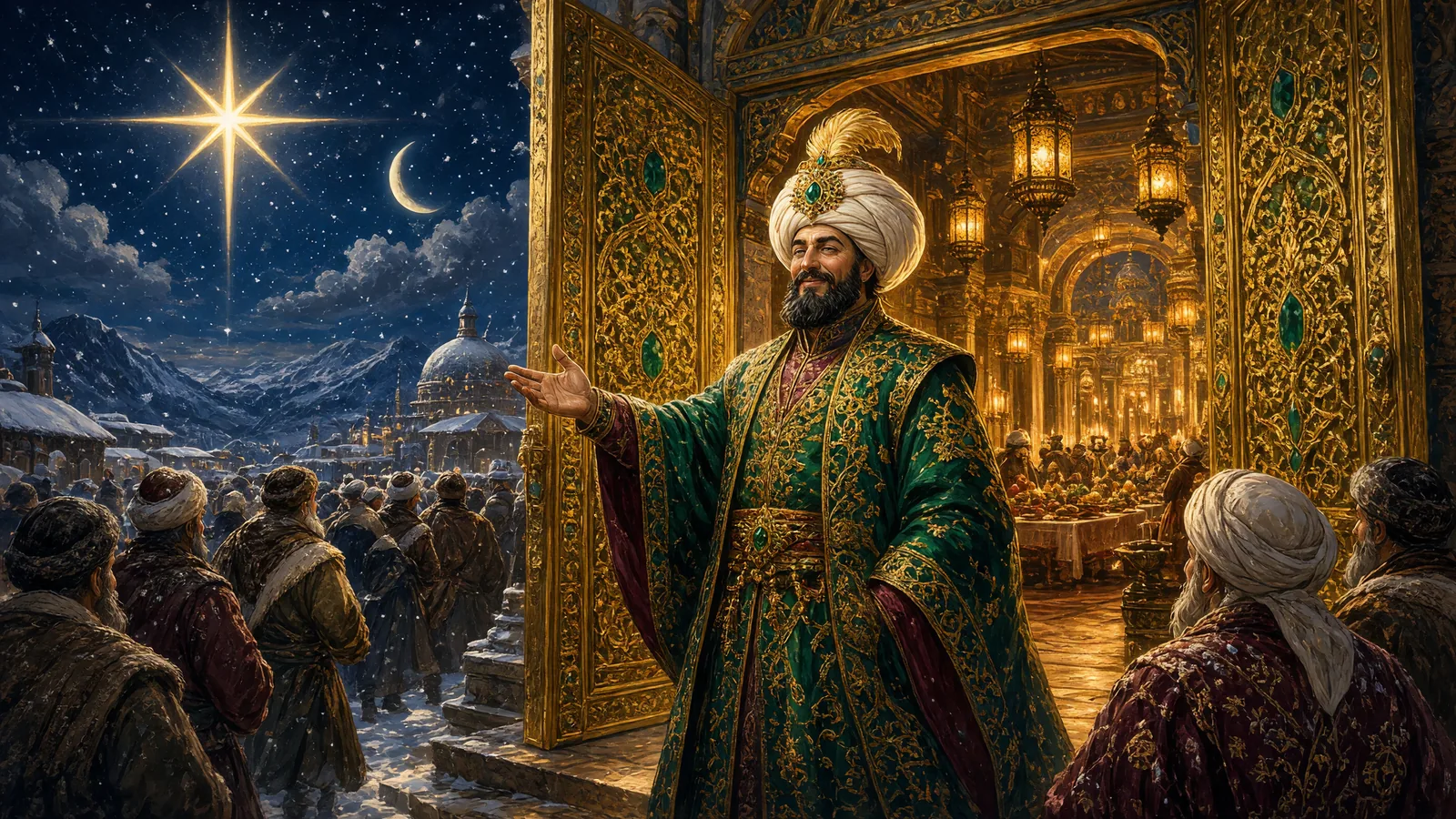
That night, after all the guests had scattered into the halls and every table was full, Aybars crossed the courtyard and went to the great door of the palace. It stood wide open. Outside, snow was falling, white, soft, silent. Asena lay before the door, her head between her paws, waiting for whoever might come along the road. Akyel dozed atop the palace dome, his wings folded.
Nilüfer came to his side.
"Come inside," she said. "The Sultan sits down last. Everyone has sat down."
Aybars looked out through the door, at the snow, at the road, at the far distance.
"Not everyone yet," he said. "There are more still to come."
Then he turned, took Nilüfer's hand, and walked into the halls. Behind him, the door stayed open.
From that day to this, that door has never closed.