
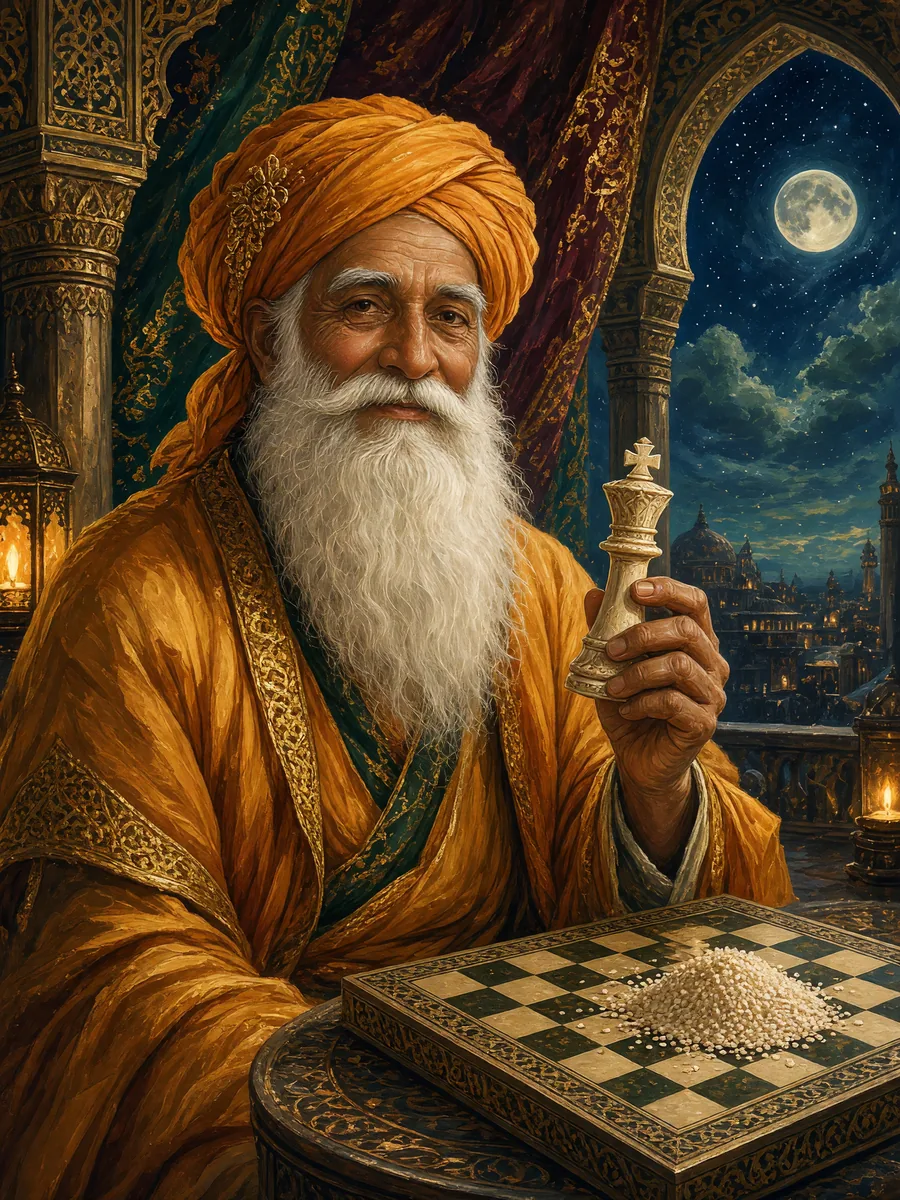
The sage from Hind who once made chess for a raja, to show "how war is not won." He defeats Erlik because Erlik is in a hurry.
- Homeland
- Hind
- His burden
- A board of sixty-four squares and a bag of rice
- Friend
- Sina Hoca (forty years of chess by letter)
- His victory
- Checkmating Erlik through the patience of a single pawn
- In the palace
- The Chess Pavilion
- Roots in legend
- The sage remembered as the inventor of chess, and the tale of the grains of rice on the chessboard
Don't play like Erlik. Play like Sissa.
His Place in Legend
A well-known legend tells that a sage in Hind invented chess and presented it to his sovereign. When the sovereign asked what he wished for his reward, the sage asked for one grain of rice on the first square of the board, two on the second, four on the third — on each square, twice as many as on the one before. The sovereign laughed at so modest a request; but when the sum was worked out, it became clear that the whole harvest of the world would not suffice.
His Path in the Story
At the harbor of Konstantiniyye he holds out a single grain of rice to the customs officer and ties his duty to the last of the sixty-four squares. The officer laughs, does not work out the sum, and waves him through. Most people don't. Their patience runs out.
He met Sina Hoca forty years before in Baghdad, and they parted agreeing on nothing at all, but loving each other dearly. For forty years they play a single game by letter. Sissa comes to finish that game. The game lasts seven days and ends in a draw; the crowd gathered in the room learns the silence of a library, of a moment of prayer.
When Erlik steps out of the corner and calls the game tedious, Sissa opens the board to him. Asked about the prize, he says, "The prize is the game itself." Erlik is fast and strong, taking piece after piece; but Sissa thinks on every move until the sand of the hourglass has nearly run out, and advances a single forgotten pawn at the edge of the board. When Erlik takes his vizier, that pawn reaches the last square and becomes a vizier. Check. Mate.
"You played this game to win, Khan. And I played it to play."
In the Palace
When his old pieces crack under Erlik's fury, he carves new ones together with Sina Hoca: the white from the dust of the Star Stone, the black from the ebony of Hind. In the crown of the white shah is a chip of Aybars's emerald.
He says he will not be able to bear the cold of the north, but when he sees the Chess Pavilion he stays: "Here, people think. A place where people think grows warm." One spring morning, in the middle of a game, he says "Your move," and never makes another. That board still stands in the pavilion in that very position, waiting for a patient player to finish it.