
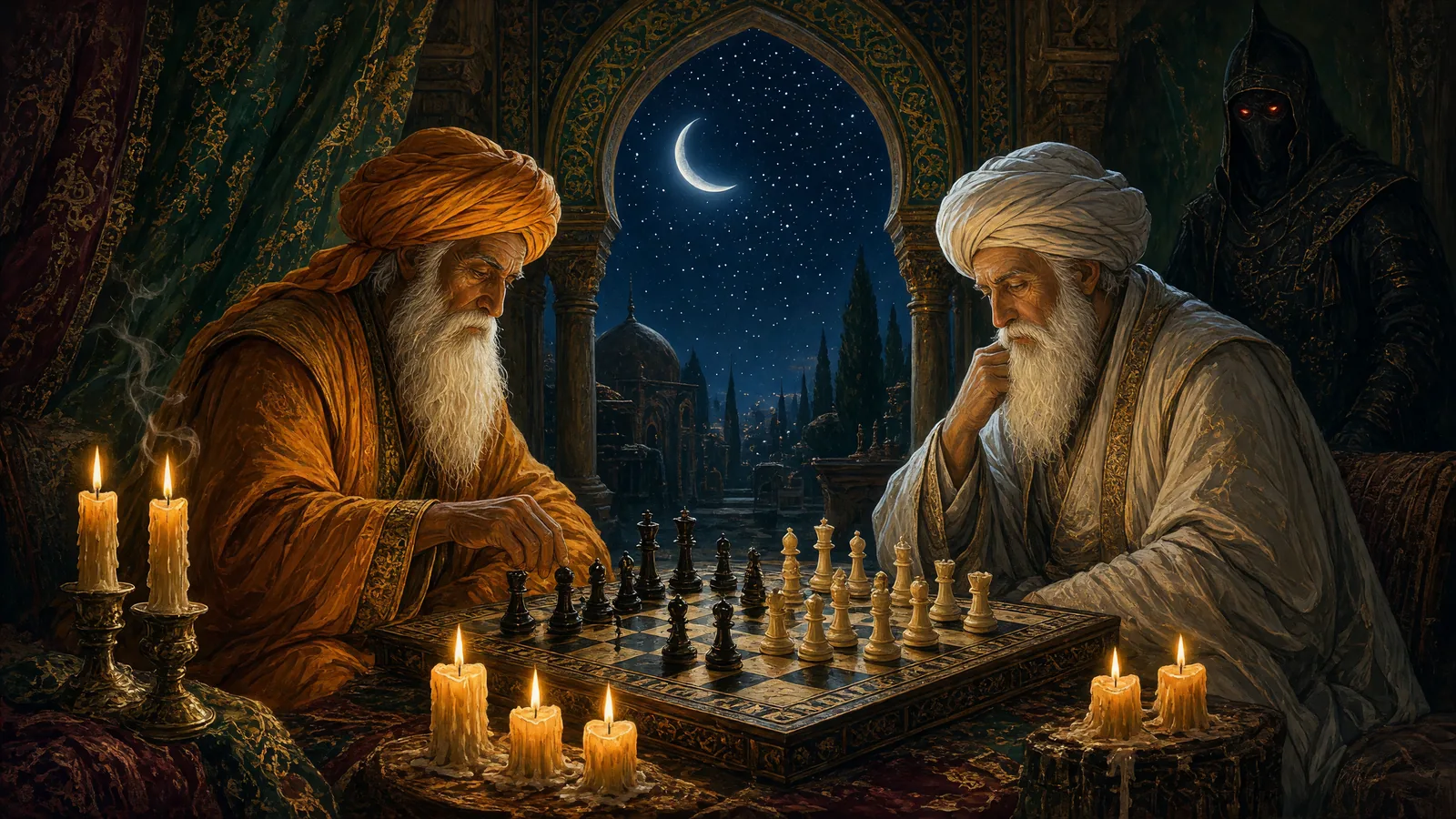
When spring came, a ship from the east drew up at the harbor of Konstantiniyye. The ship was small, its sails patched, its deck smelling of spices. Most of its passengers were merchants: they had brought black pepper, cinnamon, cloves and silk. But among them was one who sold nothing at all.
He was very old. His beard fell to his waist, white as snow. He wore a saffron-colored robe and had wound a turban of the same color about his head. He carried only one burden: a wooden box, like a draughtboard, held tight beneath his arm. And a handful of rice, in a small cloth bag.
At the harbor the customs officer stopped him. "What have you brought, old man?"
"A game," said the old man.
"A game? And what's the duty on that?"
The old man smiled, took a single grain of rice from his bag and placed it in the officer's palm. "Put this on the first square of the board. Two grains on the second square. Four on the third. Eight on the fourth. On each square, twice as many as on the one before. There are sixty-four squares. However much rice falls on the last square — let that be my duty."
The officer laughed, thought, am I to bother with a grain of rice? and said, "Go on through."
This old man was Sissa. In Hind they called him Sissa Dede — Grandfather Sissa. Had the officer worked out that sum of rice, he would have seen that not even every harvest of every field in the world would be enough. But he did not. Most people don't. Their patience runs out.
A Stranger Beneath the Dome
Sissa Dede knocked at Sina Hoca's door on the third day. Hasan Efendi opened it. He looked at the old stranger, looked at the box under his arm, then stepped aside without a single question. By now he had learned not to ask who came to this door, or why.
Sina Hoca was upstairs, in the attic. When he saw Sissa he set down the astrolabe in his hands. For a while the two old men looked at each other. Then both of them laughed at once.
"Sissa," said Sina.
"Sina," said Sissa.
Forty years before, when both were young scholars, they had met in a library in Baghdad, argued about the stars all night long, and parted in the morning agreeing on nothing at all, but loving each other dearly. They had never met again. But for forty years they had written each other letters. Every letter was a move. The moves of a game left unfinished.
"I have come to finish our game," said Sissa, and opened the box.
Out of it came a board. Sixty-four squares. Thirty-two light, thirty-two dark. And a bag full of wooden pieces: pawns, knights, bishops, rooks, viziers, shahs. The pieces were worn; some were chipped at the edges, the paint of others had faded. But Sissa set them out on the board with such care that Hasan Efendi felt he was watching the lamps of a temple being lit.
"I made this game," said Sissa. "Many years ago, in Hind, for a raja. The raja loved war. I wanted to show him how war is not won."
"How it is not won?" asked Aybars, from the doorway.
Sissa turned and looked at the young man. "You are the lord from the north. The one who carved the stones. Word of you has reached as far as Hind." His eyes smiled. "Yes — how it is not won. In this game the strongest piece is the vizier — the queen, as some lands call her. But would you win without losing your vizier? Be patient. A pawn, if it advances with patience, becomes a vizier when it reaches the end of the board. Even the smallest soldier, if he finishes the road, turns into the greatest power."
Seven Days
Sina and Sissa began to play.
On the first day no one paid them any mind. Two old men in an attic, sitting motionless over a board for hours. Now and then one of them moved a piece, and then hours of silence again. Hasan Efendi brought them tea, the tea went cold, and Hasan Efendi brought more.
On the second day Nilüfer came. Aybars had told her about Sissa's game. Nilüfer watched for an hour, then leaned to Aybars's ear: "They aren't playing. They're thinking."
"Perhaps that is the game," said Aybars.
On the third day a rumor went around beneath the dome. It was said that two old sages had been playing the same game for three days, neither eating nor sleeping. That was an exaggeration; they ate, and they slept, but they did not leave the game. On waking, the first thing they did was look at the board.
On the fourth day a crowd gathered at the door. Hasan Efendi let them in. In the attic, around the two old men, dozens of people sat in silence. No one spoke. When a piece moved, they all drew breath together.
On the fifth day Aybars noticed something. There was a strange peace in the room. People — people who did not know one another — sat side by side, looking at the same board, thinking at the same moment. No one was winning, no one was losing. But everyone was there. There was no laughter of okey here, no thrill of Batak; in their place was a deep, warm silence. Like the silence of a library. Like the silence of a moment of prayer.
On the sixth day, six of the seven candles had burned down.
On the seventh day, at dawn, Sina Hoca moved his last piece and laid his hands upon his knees.
"Stalemate," he said.
Sissa looked at the board. None of his pieces could move, yet his shah was under no threat. No one had won. No one had lost.
Sissa laughed. His beard trembled. "Forty years," he said. "A game of forty years. A draw."
"A draw," said Sina. And the two old men clasped each other's hands across the board.
The Watcher in the Shadow
At that very moment a voice came from the darkest corner of the room:
"How tedious."
Everyone turned. In the corner sat a man whom no one had noticed in all those seven days. Tall, dressed in black, eyes like embers. Erlik.
Aybars rose to his feet. Nilüfer laid her hand on Aybars's arm.
"Seven days," said Erlik, standing. "For seven days two old men played on a board, and in the end, what happened? Nothing. No winner, no loser. That is not a game, that is a sleep." He came toward the table. The onlookers drew back in fear. "I know this game too. I have played it for thousands of years. And I have never drawn. I win."
Sissa looked at him. He was not afraid. Perhaps because he was very old; perhaps because he was very wise.
"Then sit," he said. "Let us play."
"For what?" said Erlik. "What will the prize be?"
"The prize is the game itself."
Erlik laughed. A cracked laugh, centuries old. "No, old man. I do not play without a prize. If I win, this board becomes mine. This game becomes mine. And from then on, whoever plays it plays for me. In every game won, a winner; in every game lost, a loser. And the loser rises from the board and never sits again. Out of shame."
"And if you lose?"
Erlik's ember eyes blazed. "I do not lose."
Sissa paused a moment. Then he began to set out the pieces again.
"This game has no prize," he said in a calm voice. "But since you insist, I will tell you this: if you lose, everyone in this room will see you lose. And you, who have never known how to lose, will learn what losing is. That is the greatest prize of all."
Erlik and Sissa
Erlik took black. Sissa took white. The game began.
Erlik was fast. Very fast. No sooner had Sissa made a move than Erlik's hand was reaching for the board. He flung his knights forward, sent his bishops slashing diagonally, drove his vizier out into the open in the very first moves. One by one he took Sissa's pawns. Each piece he took he lined up along the edge of the board, smiling. "One," he said. "Two. Three."
The onlookers held their breath. Sissa's pieces were dwindling. Erlik's covered the board.
But Sissa was in no hurry. Before every move he thought long and deeply. Erlik grew impatient. "Play," he said. "Play, old man. You've already lost."
Sissa did not play. He thought.
Then Sina Hoca did something. He brought out an hourglass, an hourglass of glass, and set it beside the board. "For each move," he said, "one turn of the glass. When the sand runs out, you must play. But until the sand runs out, you may think. Whoever hurries loses, and whoever dozes loses too."
Erlik laughed. "I have no need of sand."
And it was true. Erlik never even had time to glance at the hourglass, so fast did he play. But on every move, Sissa's sand ran almost to the very end. And on every move, slowly, silently, he pushed one pawn forward by one square.
One pawn. At the edge of the board, one nobody was watching. Erlik did not even see it. He was busy chasing Sissa's shah, hunting his vizier. And the pawn advanced. One square. Two squares. Three.
Twenty moves later Erlik took Sissa's vizier. A murmur broke out in the room. Erlik stood and spread his arms.
"There! The vizier is gone! Half a move more and the shah goes too!"
Sissa turned the hourglass. He waited until the last grain of sand had fallen. Then he pushed that pawn — that forgotten pawn at the edge of the board — onto the last square.
"Vizier," he said.
The pawn became a vizier.
Erlik froze. He looked at the board. The new vizier threatened his shah right in its corner, leaving no way of escape. All of Erlik's pieces had gone to the far end of the board to attack. There was no one left to guard his own shah. For Erlik had never once thought of his own shah; he had only thought of taking, of gathering, of winning.
"Check," said Sissa. Then one more move. "Mate."
Losing
The room sank into such a silence that it was as if every bell in Konstantiniyye had fallen still at once.
Erlik looked at the board. For a long time. The handsomeness of his face first faded, then cracked, then fell away. Beneath it showed that ash-gray face. But this time it was not angry. It was only... bewildered.
"I," he said. His voice was like a child's. "I have lost."
"You have lost," said Sissa. Gently.
Erlik rose. He lifted his hand over the board, as though to overturn it. The onlookers cried out. But Erlik's hand stayed in the air. It did not move. Then, slowly, it came down.
"Why?" he said. "Why did I lose? I took more pieces. I was faster. I was stronger."
Sissa did not rise from the board. He lifted his eyes to Erlik.
"Because you played this game to win, Khan. And I played it to play. You saw every piece as plunder. I saw every piece as a story. That pawn, that little soldier you never once noticed, walked its road through the whole game. With patience. No one noticed it. And in the end, it took the place of the greatest." He smiled. "That is what this game is. I made it centuries ago, for a raja. The raja did not understand. Perhaps you will."
Erlik said nothing. For a moment — only a moment — the embers in his eyes dimmed a little. Perhaps for the first time, he truly thought about something. Then he turned, passed through the crowd and went down the stairs. No one stopped him. And that night, nowhere in Konstantiniyye was there the smell of a dead hearth's ashes.
New Pieces
When Erlik's hand had hung above the board — in that moment when it stayed in the air — Sissa's old wooden pieces had cracked. The weariness of centuries could not withstand the fury of a khan.
Sina Hoca gathered up the pieces and carried them to the attic window. He looked at them in the moonlight. Then he turned to the walnut table where the master set stood. The ivory dust that had fallen on the table while the hundred and six stones were being carved, gathering over forty nights, Hasan Efendi had collected into a jar. The master took the jar.
"This dust," he said to Sissa, "is the last piece left of the Iron Stake's tear. It fell while the stones were being carved. I thought it too little to be good for anything. But it is enough for thirty-two pieces."
The feather of the Zümrüdüanka glowed once more. That night, in the shadow of the dome, Sina Hoca and Sissa Dede carved a new set together. The white pieces from the dust of the Star Stone, gleaming like ivory. The black from ebony Sissa had brought from Hind, black as night. And into the crown of the white shah, carved from star dust, was set a tiny chip of the emerald from Aybars's turban.
Sissa set the new pieces out on the board and looked at them for a while. Then he turned to Aybars.
"One more table for your tables," he said. "Okey is laughter. Batak is a promise. But this game is silence. Not Erlik's silence. The silence of two people thinking the same thing, understanding each other. Set aside a corner for this, too, in your palace in the north. By candlelight, for long-considered moves."
Aybars bowed his head. "I promise, Dede."
Sissa Dede placed the bag of rice in Aybars's palm. "And take this too. If one day someone asks you how precious patience is, give them a single grain of rice and tell them about the sixty-four squares."
The Hourglass
From that night on, Sina Hoca's hourglass never left the side of the chessboard. Later the master improved it: two hourglasses of two glasses, one for one player and one for the other. While one player thinks, his sand runs and the other's stands still. When you make your move, yours stops and your opponent's begins. So no one can think forever, and no one plays without thinking.
Today, in the chess hall of the palace of the north, those hourglasses are the first ancestors of the clocks ticking beside every table. And when someone hurries over a move, the old masters still tell them:
"Don't play like Erlik. Play like Sissa."
As for Erlik, after that night he vanished for a while. Some said he had gone back to the underworld, and that in the pain of losing he would play alone on his own board for centuries. Others said he was gathering his fury, preparing one last blow.
The second group was right.