
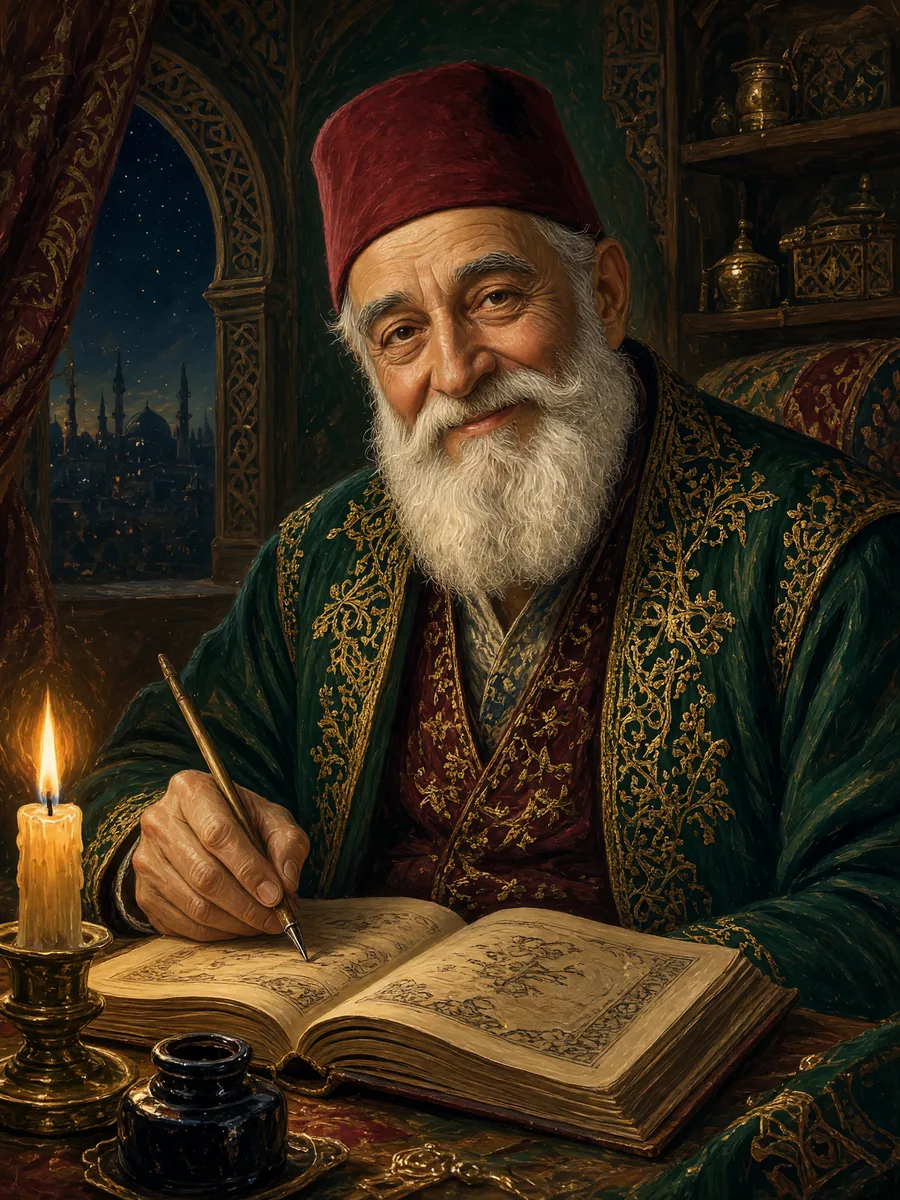
Sina Hoca's scribe, assistant, cook and bookkeeper. He writes everything down and never forgets what he has written; but he never remembers where he put his spectacles. The fourth player at the first table.
- Office
- Scribe; in his own words, "the memory of the house"
- Emblem
- Red fez, reed pen, ink-stained fingers
- His inventions
- "The bid"; the palace emblem; the fair copy of the palace custom
- Famous sum
- 4 × 13 × 2 + 2 = 106
- In the palace
- The ledgers on the library's highest shelf
- In the game
- Hasan Efendi at the table
Wherever the Hoca goes, there go I.
Who he is
Whoever knocks at the door beneath the purple bougainvillea is greeted by him: red fez, white beard, round spectacles, reed pen in hand, fingers stained with ink. He writes down everything Sina Hoca says and never reads it again, because once he has written a thing he never forgets it. His spectacles, however, are usually perched on his forehead, and he does not know it.
Whoever comes to the door, whatever they bring, even if it is a wolf or a winged horse, he raises his eyebrows for a moment, lowers them, and steps aside. In time he learns not to ask who comes to this door, or why.
His path in the story
Through the forty nights in which the stone is carved, it is he who counts the tiles and sets them in rows. On the fortieth night he says "One hundred and four"; when two green tiles appear, he writes his famous line in the ledger: 4 × 13 × 2 + 2 = 106. The sum holds. It is also he who thinks of Fatma Nine for the rack.
When Erlik knocks at the door, Hasan remembers Fatma Nine's words and lets him in. He does not know how dearly this will cost them, yet he never speaks of it with regret. In the Paper Palace, being a scribe who understands contracts, it is he who devises Batak's bid: "Whoever makes the highest offer takes the job. But if he cannot finish it, he loses as much as he offered." It is he who writes the sign over the Kahvehane door: "Here no one loses."
He always keeps the fig accounts. For the single fig fed to Akyel, he writes in the ledger: "One fig, for the patience of a winged steed. A fair price."
In the palace
On the morning after the night of the crowning, he draws the emblem of the palace: "The crown is the palace's, the star is the road's, and the crescent is protection's." It is also he who makes the fair copy of the palace custom in the leather-bound volume; he mixes up whose article is whose, but no one corrects it.
He writes down Sina Hoca's last words and lays down his pen. His ledgers stand on the highest shelf of the palace library; no one has ever managed to read them all, because Hasan Efendi wrote down everything.