
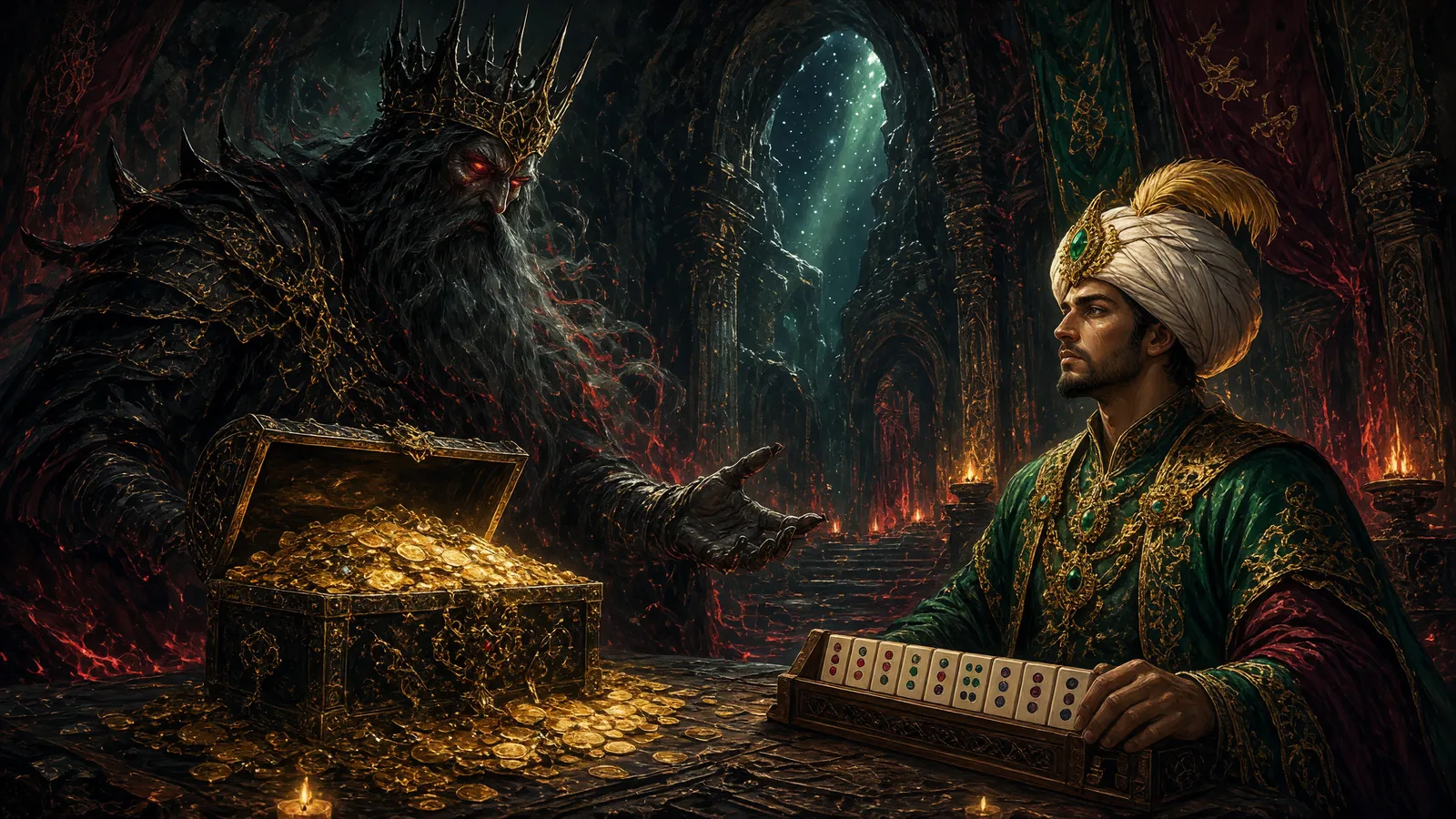
The sound of the table spread through the city.
The neighbors heard it first. Those passing the door with the purple bougainvillea heard that strange, sweet sound drifting down from under the roof, the shuffle of ivory tiles on a walnut table, and after it the laughter and the cries of "Okey!", and they stopped, curious. One evening Hasan Efendi opened the door and invited them in. The next evening ten people came. A week later, forty.
Sina Hoca's house was small. There was only one table. But Aybars had the carpenter make four more tables, and new racks from the wood left over from Fatma Nine's walnut branch. There was only one set of tiles, but Sina Hoca discovered a secret: every tile carved from the Star Stone, if it had been played with love at a table, left behind a shadow of itself. The master had these shadows worked into ordinary ivory. And so there was a new set for every table. The first set, the one carved from the tear of the Iron Stake, the mother set, always stayed on the long table beneath Sina Hoca's roof.
By the time winter came, half of Konstantiniyye had learned to play okey. In coffeehouses, in mansions, in gardens, in boats. Poor and rich, young and old, native and stranger. And a curious thing happened: the quarrels in the city grew fewer. People began to leave their doors open in the evenings. Shopkeepers who shouted at one another in the market sat at the same table at night and drank tea together. When four people share a table, no one can stay sullen with anyone for long; for without the fourth, there is no game.
Deep beneath the earth, Erlik heard of it. And this time a whisper would not be enough. He decided to come himself.
The Visitor
It was a Friday evening. Once again four people sat beneath the roof: Sina Hoca, Aybars, Hasan Efendi, Fatma Nine. In the corner, the empty chair. The tiles had just been shuffled. Outside, the rain was falling.
There came a knock at the door. Hasan Efendi opened it.
At the door stood a tall man dressed all in black. His coat was of costly cloth, there were rings upon his fingers, and his beard was carefully combed. His face might have been called handsome, but there was something strange about it: the rain was falling on him, yet the man was not wet. The drops turned to steam before they touched him.
"Good evening," said the man. His voice was like velvet. "There is talk in the city of a certain game. I too am fond of games. May I come in?"
Hasan Efendi hesitated for a moment. Then he remembered Fatma Nine's words: The hundred is yours, and the one is for whoever will walk through the door. He stepped aside.
"Please, come in."
The man climbed the stairs. When he entered the room beneath the roof, the flames of all forty candles bent at once, as though a wind had blown. Asena, who had been sleeping by the door, sprang to her feet in a single bound, her fur bristling, and began to growl. But when the man looked at her, the wolf took a step back. It was the first time Aybars had ever seen Asena back away from anything.
And then came that smell. The ash of a dead hearth.
Aybars rose to his feet. "I know you."
The man smiled. "We have met. But this time I have come myself, not my shadow. It is a discourtesy for one khan to send his shadow to another khan's table." He glanced at the empty chair. "Is this seat free?"
"That chair," said Fatma Nine, and her voice did not tremble, "is for a guest. But you are no guest."
"I am no guest," said Erlik Han, and for a moment his smile widened until it spilled past the edges of his face. "I am a buyer."
The Offer
Erlik did not sit. He stood at the head of the table, clasped his hands behind his back, and looked at the tiles. For a long, long time. The way a jeweller looks at a gem: reckoning its worth.
"Fine work," he said. "Truly fine. One hundred and six tiles. Four colors. From the tear of a stake. Sina, you were always a good craftsman." The master did not answer. "And this game. Half the city plays it. The other half is learning. In a year the whole land will be playing. Do you know what that means?"
"What does it mean?" said Aybars.
"It means money, young man. Money."
He raised his hand. In the middle of the room, directly above the table, a chest appeared. Black oak, bound in iron. Its lid opened of its own accord. It was full of gold. Gold coins, gold ingots, gold chains. When the candlelight struck the gold, the room filled with a yellow glitter. Hasan Efendi's spectacles slid down his nose.
"This," said Erlik, "is a beginning. Give me the tiles. All of them. The mother set and its shadows. In return, ten times this chest. A hundred times. Whatever you wish."
"And what will you do with the tiles?" said Sina Hoca. His voice was calm, but his eyes had gone red.
Erlik shrugged. "I? Nothing. Let the game be played, I say. Let it be played more. But with one difference." He raised a finger. "For money. A coin for every hand. Let the winner take, let the loser pay. Let whoever sits at the table set down his purse. The bigger the purse, the bigger the table. That way the game becomes serious. People pay attention. Greed comes, excitement comes. And I..." he smiled, "take a small share. From every table. From every hand."
"And the people?" said Aybars.
"What of the people?"
"The losers. Those whose purses are emptied. What becomes of them?"
Erlik paused for a moment, as though he had never once thought about the question. Then he laughed.
"They go home, young man. They close their doors. They speak to no one. They are ashamed. They never sit at a table again." For an instant his eyes glowed like embers. "And the table empties once more. And once more there is silence. My silence."
The Refusal
No one said a word.
The candle flames still leaned. The rain drummed upon the roof. Asena had stopped growling and was pressed against Aybars' leg. The gold in the chest drank in all the light in the room and scattered it back again.
Aybars looked at the table. At the tiles. At the walnut racks. At Fatma Nine's tea glasses. At Hasan Efendi's ledger. At Sina Hoca's trembling hands. At the empty chair in the corner, and the withered white flower still lying on its seat.
Then he remembered Kara Toğrul's hall. Forty chairs. A single plate. And his father's last words.
He laid his hand upon the table, upon the rack of the mother set.
"My father spent a whole lifetime hoarding something," he said. "It was not gold. It was silence. He told me so as he was dying. I do not know how much gold is in your chest, Erlik Han. But I know what is inside it. My father's hall is in that chest. Forty empty chairs."
He closed the lid of the chest. The heavy oaken lid slammed shut like a gravestone.
"No money changes hands at this table. The only thing won at this table is conversation. The one who loses wins conversation, and so does the one who wins. The worth of the tiles lies not in whose hand holds them, but in whose hands they pass between. Take your chest, and go."
Slowly Sina Hoca rose and came to stand beside Aybars. Hasan Efendi closed his ledger and rose. Fatma Nine set the teapot down on the table and rose. The four of them stood on one side of the table, shoulder to shoulder. The empty chair in the corner, though no one touched it, slid a hand's breadth forward.
Erlik looked at them. In an instant the handsomeness faded from his face, and beneath it another face showed through: ash-gray, cracked, its eyes two deep wells. A crown appeared upon his head, of black iron, sharp-pointed. His beard turned to smoke.
"Fools," he said. His voice was velvet no longer; it came from the bottom of a cave. "If you will not bind your table to money, then I will leave it incomplete. Let us see how much companionship you find at an incomplete table."
The Theft
He reached his hand toward the table. Aybars threw himself forward, but he was too late. Erlik's fingers passed over the tiles, and two tiles, the two green-marked tiles, rose from the table and flew into his palm.
The false okeys.
"Hızır's tiles," said Erlik, closing his fist. "The two tiles that can be anything. Without them your hand will always lack one tile. Your run will always be half finished. Your hand will never open. Let us see how you reach one hundred and one with an incomplete set."
He set his foot upon the chest. The chest sank into the floor, pierced the boards, and fell into the dark. Erlik went with it. A wisp of smoke, a smell of ash, a peal of laughter, and in the room the candle flames stood straight once more.
Erlik was gone.
And on the table, in the mother set, one hundred and four tiles remained.
Silence
For a long time no one spoke. Then Fatma Nine sat down, took up the teapot, and poured tea for everyone.
"Sit," she said. "No trouble was ever solved standing up."
They sat. Aybars looked at the tiles. Where Erlik's hand had passed, the ivory had darkened faintly.
"The game can still be played," said Hasan Efendi, trying to collect himself. "The indicator is turned, and Hızır's true tile is still the okey. Even without the false okeys..."
"It can be played," said Sina Hoca. "But it will be played incomplete. Those two were no ordinary tiles, Hasan. They were the trace Hızır left upon the table. The place at the table for unexpected kindness. Without them the game becomes a sum. Who holds what, how many points, who won. That little piece of miracle inside it is gone."
Aybars rose. He went to the window. The rain had stopped. Above the dome the clouds were scattering, and the Iron Stake was beginning to show.
"I will take them back," he said.
"From Erlik's hand?" said Hasan Efendi. "Will you go down into the underworld?"
"I do not know. But there is a way." Aybars turned. "Sina Hocam, you taught me something. Knowledge belongs to the one who knocks at the door. I will knock at doors. At every door in this city."
Fatma Nine smiled. "Sleep first, my child. The doors won't run away by morning."
But Aybars did not sleep that night. He went down into the city with Asena. And toward dawn, in the narrowest street of the Grand Bazaar (Kapalıçarşı), as a coffee-keeper was raising his shutter, he found the first clue.