
By the time Aybars returned to Konstantiniyye, autumn had come. Migrating birds passed over the dome, and the chestnut roasters were setting up their stalls in the streets. The door with the purple bougainvillea stood open as always. At the threshold Hasan Efendi took the pouch of figs, opened it, and counted.
"One is missing."
"I fed it to the tulpar. He earned it."
Hasan Efendi thought for a moment, then nodded and drew the pouch closed. "I will not tell the master," he said. "But I will write it in the ledger."
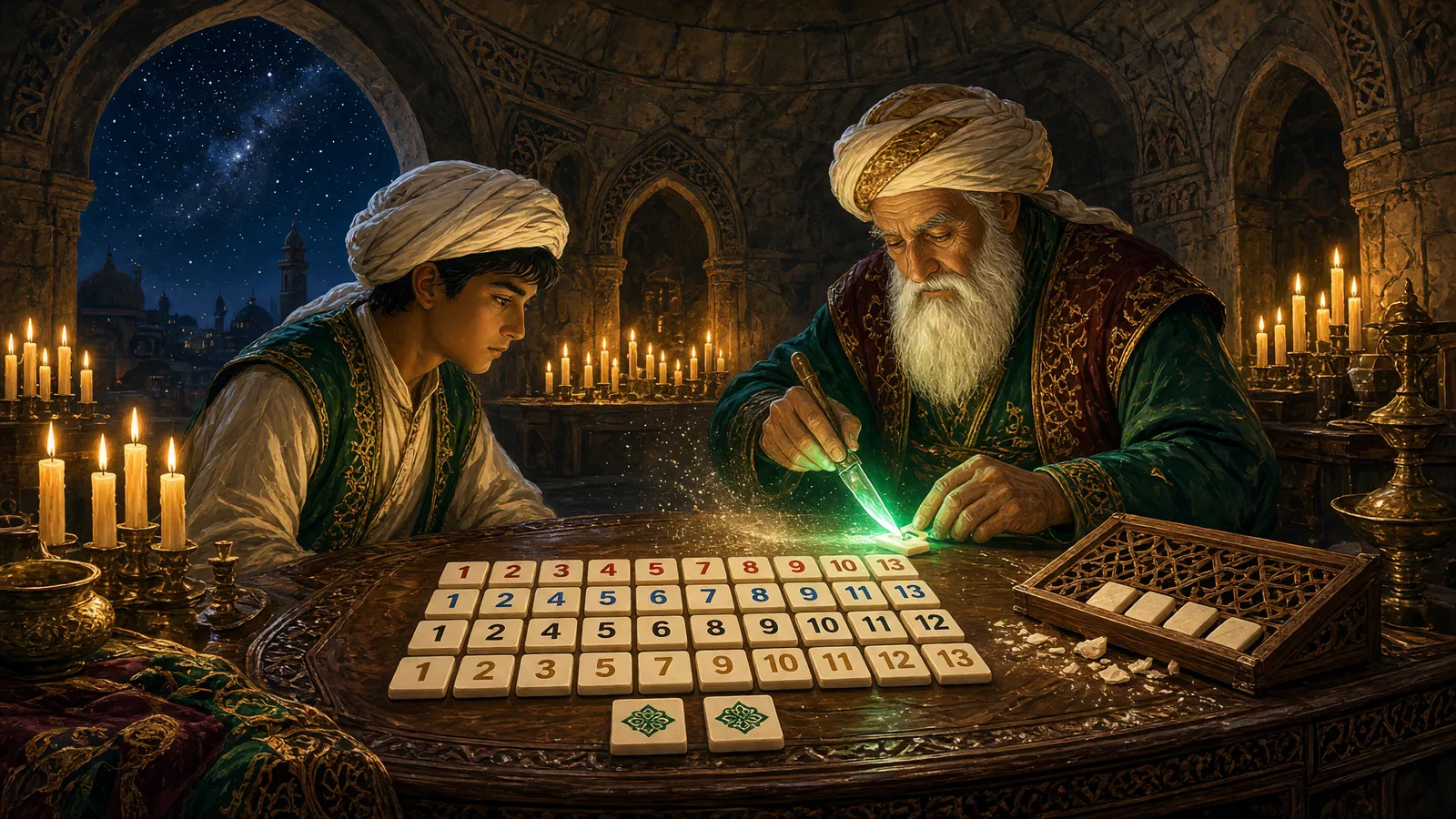
Sina Hoca was upstairs, in his workshop under the roof. In Aybars' absence he had changed the room entirely. The books had been carried down, the shelves emptied, and a long walnut table set in the middle of the floor. Around the table stood a ring of forty candles. The little window in the very center of the ceiling had been opened so that, when night fell, it would frame the Iron Stake. On the walls hung hundreds of calculations the master had drawn in ink: numbers, circles, proportions.
"Did you bring it?" said the master, without so much as a greeting. Then he caught himself, smiled, and embraced Aybars. "Welcome home. Did you bring it?"
Aybars laid Şahmeran's pouch and Zümrüdüanka's feather on the table. The golden serpent clasping the mouth of the pouch saw the master and let go of its tail; the pouch fell open, and the serpent slid down from the table and out through the window. It was going home to Tarsus.
The four spheres settled at the four corners of the table. The feather quivered in the candlelight like an emerald flame. And in the middle of the table Aybars set down the stone he had carried over his heart for months.
A silence fell over the room. Even the candles stopped flickering.
The Reckoning
"First, the reckoning," said Sina Hoca.
He pointed to the drawings on the wall. "We cannot cut this stone until we know how many tiles lie hidden inside it. I have been thinking for forty nights. When we look with the feather we will see, but I have made a rough reckoning. Listen."
"There are four colors. Red, blue, black, yellow. Şahmeran told you: fire, water, earth, sun. The four sides of a table. Let four people sit at it, each at one side."
"Within every color there are numbers. How many? I watch the sky, you know. In a year the moon is born thirteen times and thirteen times grows full. Some years it is twelve, but the old Turks counted thirteen; ask Hasan."
"They wrote down what they counted," said Hasan Efendi from the doorway. "I have read it."
"Thirteen numbers, from one to thirteen. One the smallest, thirteen the greatest. But look, mark this well: after thirteen comes one. So it is with the moon too; the year ends, and begins again. Never think a one is small on its own; when it follows a thirteen, it turns back to the very beginning."
Aybars would come to understand this very well later, at the table. At the end of a run, twelve, thirteen, one: the year closes, and a new year opens.
"And two of every tile." The master raised two fingers. "Why two? Because we want nothing in this world to be alone. Let every red seven have its twin. If one is lost, let the other take its place. If a tile is left alone at the table, let it know that somewhere it has a twin."
He wrote a number on the wall. 4 × 13 × 2 = 104.
"A hundred and four tiles," said Aybars.
"A hundred and four," said the master. "But the reckoning does not hold." He pointed to the stone. "This stone weighs too much for a hundred and four tiles. There is something more inside it. What it is, I do not know."
Forty Nights
They began on the first night. When the Iron Stake appeared in the window in the ceiling, Sina Hoca took up the feather and touched it to the stone.
The stone opened. It did not split; it did not break; it opened, like a flower. Out of it rose a map of light that hung upon the air. On the map were hundreds of small shapes; each one a tile, each with a number inside it, each number with a color. Wherever the feather touched, it parted these shapes from one another, and every piece that came free drifted gently down onto the table and became a tile of ivory.
But the work was not as easy as it looked. Each time a tile was parted, the color within it awoke. And the awakened color wanted to flee.
When they parted the first red seven, the red leapt out of the tile like a flame and flew toward the window. Aybars remembered what Şahmeran had told him. He seized the red sphere and set it beside the tile, and the sphere trembled with the crackle of a hearth. At the edge of the window the red turned back, knew the sound, and returned into the tile. Beneath the seven it left a small mark.
On the second night the blue fled. The murmur of a well brought it back. On the third night the black returned to the voice of the earth. On the fourth night the yellow, to the crowing of a cock. After the fifth night the colors fled no more. They had seen one another. Each tile, as it came free, settled on the table beside its brothers and sisters of the same color.
It took forty nights. Every night Aybars held the feather, the master read the opening map of the stone, and Hasan Efendi counted the tiles and set them in rows. Asena kept watch at the door. Akyel kept watch in the garden, beneath the fig trees. The candles burned down and were renewed. Above the dome the moon did not fill thirteen times, but once it filled, and once it waned.
And every night, when the work was done, Aybars saw that the tiles had arranged themselves side by side of their own accord. Red five, red six, red seven. Or red nine, blue nine, black nine. A run, a set. Without anyone telling them, the tiles found one another. Just as Umay Ana had said: Alone, everyone is a number. Side by side, they become a story.
Two Tiles More
On the fortieth night Hasan Efendi counted the last tile. "A hundred and four," he said.
But in the middle of the table, something still remained of the stone's opened map. Two small lights. They were not red, nor blue, nor black, nor yellow. They were green. The green of a fresh leaf, like the first shoot of spring. And there was no number within them. Only a mark: small, curling, like a leaf or a sprouting clover.
Sina Hoca frowned. "This was not in my reckoning."
He brought the feather closer. The two lights came apart and fell onto the table: two ivory tiles, the green mark upon each.
Aybars looked at them, and all at once his breath caught. He had seen this mark before. At the foot of the mulberry tree, beside the single white flower that had bloomed in the dead of winter, on the trampled grass. The trace of the green cloak had been this very shape.
"The traveler at the crossroads," he whispered. "The riddle."
Sina Hoca and Hasan Efendi looked at him. Aybars spoke the riddle again:
"There is a tile that can be any tile.
If it wants red, it is red; if it wants blue, it is blue.
If it wants seven, it is seven; if it wants thirteen, it is thirteen.
It fills the place of what is missing, yet yields its own place to no one."
Sina Hoca was silent for a long time. Then, slowly, he began to laugh, great peals of laughter. He laughed until the tears ran from his eyes, until his beard shook, until the flames of all forty candles suddenly danced.
"Hızır!" he said. "Hızır, my child! The old man you shared your bread with at the crossroads was Hızır! Hızır, who reaches those stranded on the road, who holds out a hand to those in need, who brings the spring, who passes from one guise into another! No one recognizes him, because he can be anything. He becomes a beggar, a king, a child, an old man. Whatever is missing, that is what he becomes."
He picked up one of the green-marked tiles and held it to the light.
"And so it will be with this tile. Whatever tile is missing to complete a hand, it will take that tile's place. But it cannot always do so. First one must know which tile on the table will be Hızır. Hızır is not everywhere, Aybars; he is always one step beyond. At the table we turn one tile face up, and we call it the indicator. The tile one higher than the indicator is Hızır's tile. If your indicator is a red five, then the red six can be any tile at all. And these two green-marked tiles, because they are not themselves, stand in for the true Hızır: the false okey."
"Okey?" said Aybars.
"Okey," said the master. "In the old tongue it means done, it fits, it is whole. Hızır's tile says okey to every hand. It makes it whole."
Aybars, who had searched for the riddle's answer for months, held the tile in his palm that night and at last understood: the one tile that can be every tile is the most precious of all; because it thinks less of being itself than of what is missing.
Hasan Efendi wrote in his ledger: 4 × 13 × 2 + 2 = 106. The reckoning holds.
The Walnut Tree
The tiles were ready, but one thing was still missing. A rack, to hold each of the four players' tiles in a row, hiding them from everyone else yet letting the player see them with ease. The master said the rack must be made of wood. But not any ordinary wood; the tree that would carry these tiles must itself have borne witness to companionship.
Someone came to Hasan Efendi's mind.
On the far shore of the Bosphorus, on the slopes of Üsküdar, there lived a woman known as Fatma Nine, Grandma Fatma. No one knew her age; she herself said she had forgotten it. In her garden stood an old walnut tree that her grandfather's grandfather had planted. For half a century, beneath that tree, Fatma Nine had laid a table every afternoon and called in whoever passed her door. Neighbors, travelers, street children, peddlers. The tree's shade had listened to so many conversations that the old folk said you could still hear the old stories in the rustling of its leaves.
Aybars and Hasan Efendi took a rowing boat across. Fatma Nine received them beneath the tree, at the head of her table. She was a plump woman in a white headscarf, her face as red as an apple, her eyes always smiling. Without asking a single question, she set tea before them, and börek, and jam.
Aybars told her his trouble. Fatma Nine listened, nodded, then looked up at the walnut tree.
"Last winter," she said, "a storm broke one of its branches. A big branch. I couldn't bring myself to chop it up for firewood; it's still lying in the barn. I think the tree was waiting for something." She smiled. "Take it. But on one condition."
"What condition, Nine?"
"You'll let me play the first game. I want to learn too."
The First Table
They brought the branch to Konstantiniyye. A master carpenter worked for three days and carved four racks: long and slender, with two shelves inside, their edges adorned with curling carvings. The more the walnut was polished, the deeper it turned to the color of dark honey, and a warm scent rose from within it.
One Friday evening, in the house in the shadow of the dome, at the long walnut table beneath the roof, four people sat down.
Sina Hoca in the north, beneath the Iron Stake. Aybars in the south, before the window that looked out on the dome. Hasan Efendi in the east, his ledger at his side. Fatma Nine in the west, the teapot at her elbow.
The tiles were turned face down and shuffled. That sound... Aybars never forgot that sound as long as he lived. One hundred and six ivory tiles being shuffled on a walnut table. Like dry leaves rustling in the wind, like a stream rolling its pebbles, like the murmur of a crowd heard from far away. And when that sound began, the Star Stone, for the first time, spread through the whole room the warmth it had kept hidden inside for months.
The master explained the rules. The tiles were dealt; fourteen, fifteen, twenty-one, how many each should take was settled only after long debate. The indicator was turned: a yellow four. So the yellow five was Hızır's tile. Hasan Efendi wrote it down. Fatma Nine did not understand; Aybars explained it to her again. Fatma Nine still did not understand; Sina Hoca explained it. This time Fatma Nine understood, and said, "Why didn't you say it like that in the first place?"
The first hand took a long time. A very long time. No one knew the rules properly; the rules were written as they played. Should a tile be discarded to your neighbor, or into the middle? How many points does it take to lay down your hand? Sina Hoca said one hundred. A hundred is the number of completeness; an old man who reached a hundred years was said to have lived a whole life.
But Fatma Nine objected.
"Not a hundred," she said.
"Why not, Nine?"
"At my table I always set one place more. Just in case, in case a guest should come. If you say a hundred, your hands will be full, but there'll be no room for the guest. Say one hundred and one. The hundred is yours, and the one is for whoever will walk through the door."
A silence fell over the table. Then Sina Hoca slowly opened the ledger, took the pen from Hasan Efendi's hand, and at the very top, in his own hand, wrote in great letters: ONE HUNDRED AND ONE.
This is the story of 101. To lay down your hand you need one hundred and one points; the hundred is yours, and the one belongs to the guest who has not yet come.
The Traveler at the Door
It was past midnight. Fatma Nine had won three hands in a row, and Hasan Efendi had written that down too, but no one cared, because at that table winning and losing meant very little. Each time a hand ended, the tiles were shuffled again, the tea was freshened, and someone told a story.
Just then there came a knock at the door.
Hasan Efendi went to open it. There was no one there. Only, on the threshold, in the cold of November, a single white flower in bloom. And at the end of the street, in the shadow of the dome, a green cloak fluttered and was gone.
Hasan Efendi picked up the flower, carried it upstairs, and set it in the middle of the table.
In that moment the two false okeys, lying on the table, glowed faintly of their own accord.
Aybars smiled. "Let's set one more chair at the table," he said. "Even if it stays empty."
Fatma Nine got up, fetched a chair from the kitchen and set it at the corner of the table. From that day on, in that house, every evening that okey was played, a chair stood waiting, empty, in the corner. And no one ever knew when Hızır sat down in it, or when he rose. But somehow, at that table, someone's hand was always made whole at the very last moment by an okey that arrived just in time.