
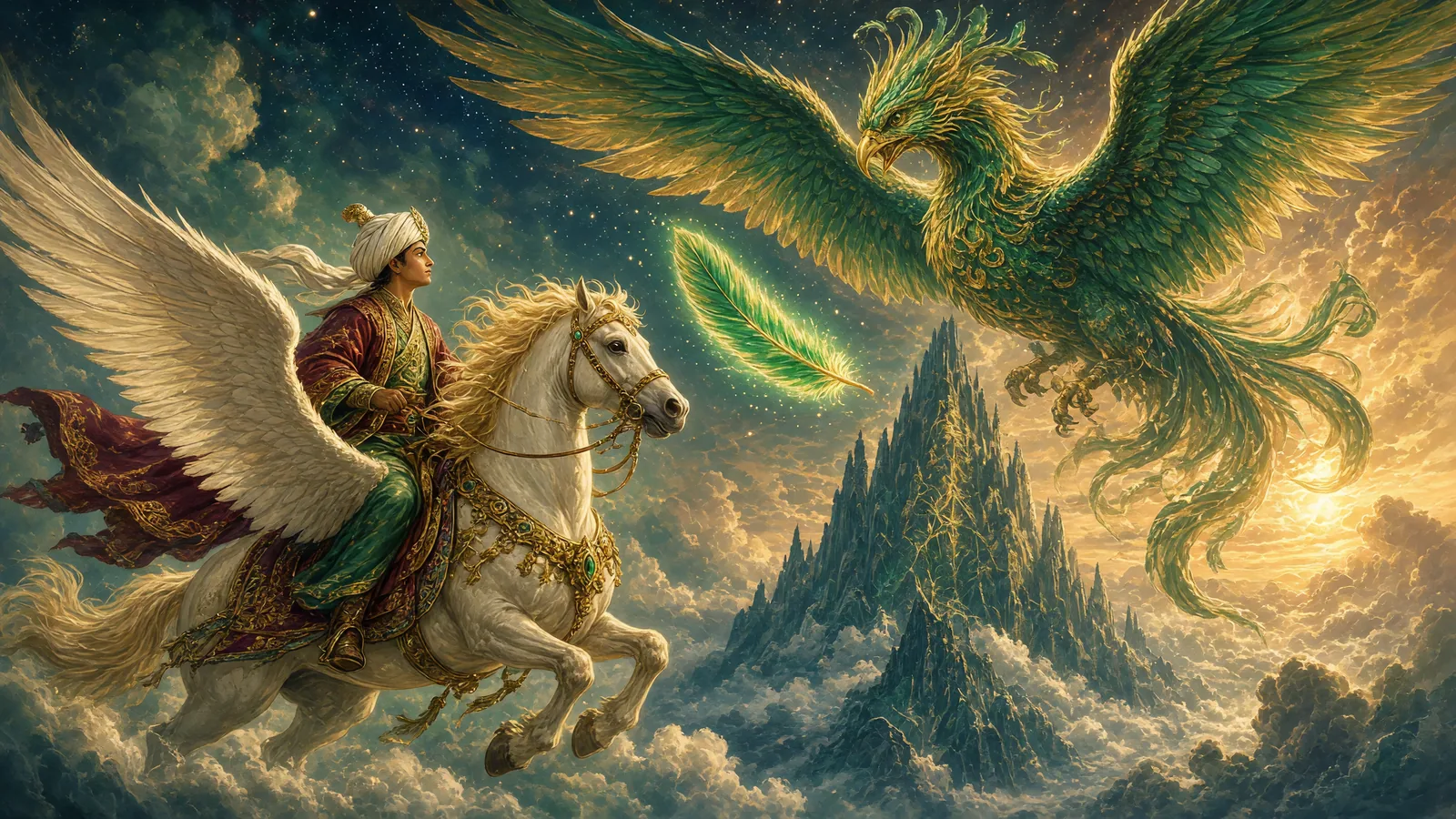
No one knows where Mount Kaf stands. Some say at the farthest edge of the east, some say at the farthest edge of the north, and some say it is a ring that encircles the whole world, so that it is everywhere and nowhere at once. The traveler's notes that Sina Hoca had given him were little help. Half of them could not be read, and the half that could ended like this:
No one seeks the road to Kaf. Kaf rises before the one who has lost his road. On the day I began to search for it, I found my way, and I never saw the mountain again.
Aybars read the notes three times and understood them not once. He looked at Asena. Asena yawned. He looked at Akyel. But Akyel had lifted his head toward the sky, and his wings, for the first time since he had come out of the ice, were trembling.
"Do you want to fly?" Aybars asked.
The tulpar did not answer. But slowly he opened his wings, and opened them, and opened them still. When the wind filled them they grew so vast that their shadow fell over Aybars like the roof of a tent.
Wings
In all the time since he had freed Akyel from the ice, Aybars had never once seen him fly. He had run, he had leapt, he had crossed whole hills in a single stride, but his wings had always stayed folded. One day Aybars had asked him, "Why don't you fly?" and the tulpar had turned his head away. Then Aybars had understood. Akyel's old master had shut him in the ice for a hundred years. For a tulpar, a hundred years is long enough to forget how wings are opened. Or perhaps he had not forgotten at all. Perhaps he was afraid.
Now, above the orange groves of Tarsus, in the hour of dawn, Akyel had spread his wings. But he did not rise. His wings shivered and his hooves pawed at the earth.
Aybars climbed onto his back. He laid a hand on the tulpar's neck.
"Do you know," he said, "after my father died, I forgot something too, for a while. How to laugh. Then a wolf laughed in my place. Have you ever seen Asena laugh? It is a very ugly laugh." Asena growled as though offended. "But it worked. Sometimes you cannot remember a thing on your own. When someone is beside you, you remember."
He leaned down to Akyel's ear.
"I am here. If we fall, we fall together."
The tulpar trembled once more. Then he began to run. From one end of the garden to the other, between the orange trees, over the old Roman bridge. He beat his wings once. His hooves left the ground. Once more. He rose. Once more. And Tarsus, the Taurus Mountains, the Mediterranean, all of it shrank in an instant and lay spread out below them like a carpet.
Aybars never forgot that moment as long as he lived. The wind struck his face, and the tail of his turban streamed like a banner. Down below, on the ground, Asena ran like a shadow, and when she came to the lip of a ravine she stopped and howled at the sky. And Akyel neighed; but this time not in pain. It was like the cry of a child running into the sea for the first time, half fear and half joy.
Losing the Way
They flew for three days. First east, then north, then toward somewhere whose direction they could not name. Aybars kept thinking of that strange line in the traveler's notes: Kaf rises before the one who has lost his road.
On the evening of the third day they found themselves in the middle of a sea of cloud. There was no earth below and no sky above; everything was white. They could not tell whether the sun had set or had just risen. Akyel was tiring. Aybars unrolled the map, and the wind snatched it from his hands. He looked at his compass; the needle spun like a mad thing. He searched for the Iron Stake; it was nowhere to be seen behind the clouds.
In that moment Aybars understood that he had lost his way. And in the very moment he understood it, he was not afraid. For Akyel was with him. The stone lay over his heart. Şahmeran's pouch lay against his chest. Somewhere far below, Asena was waiting for him. And far away, in the shadow of the dome, Sina Hoca and Hasan Efendi were laying the fire. He had lost his way, but he had not lost himself.
"Very well," he said aloud, to the clouds. "I am lost. But I am not alone."
The clouds parted.
The Mountain
Mount Kaf stood before them. How high it was, no one could ever have said; its summit passed into the sky itself, and its foot vanished beneath the clouds. Its slopes were emerald green, its rocks the color of gold, its waterfalls like silver. And on the summit, within a nest, sat Zümrüdüanka.
The bird was so great that when she spread her wings she could have hidden the sunset. Her feathers were every shade of emerald and gold and midnight blue, and each one shone with a light of its own. Her tail flowed down the mountainside like a river. Her eyes... When Aybars looked into those eyes, it was as though he saw every library in the world at once. A thousand years of knowledge were there, perhaps ten thousand. But above the knowledge lay something more: a very deep weariness.
Akyel alighted on the summit, folded his wings and knelt. Aybars stepped down.
"Child of the earth below," said Zümrüdüanka. Her voice was not speech but wind; every word passed straight through Aybars and on. "No one comes here so easily. When they lose their way they weep, they shout, they pray. You said, 'I am not alone.' The last one who said that came here five hundred years ago."
"Şahmeran sends her greetings," said Aybars. It was the first thing that came into his head.
Something gleamed in the bird's eyes. "Şahmeran... Is she still alone in her cave?"
"With her serpents. But I promised that if I ever set a table, I would make a place at it for her."
Zümrüdüanka was silent for a long while. The wind moaned across the summit.
The Fledglings
"I know what you want," said Zümrüdüanka at last. "A feather. A blade of light to carve your stone. Sina's plan. He is an old friend of mine; once, long ago, he came here to ask about the stars. I gave him something too. His eyes. Those sharp eyes of his, he had from me."
Aybars remembered Sina Hoca's eyes, and smiled.
"But I do not give for nothing," said the bird. "I asked something of Sina. And I will ask something of you."
She lifted her wing a little. Beneath it, in the nest, were three fledglings. They were small, yet each was as big as a sheep. They had no feathers yet, only a golden down, and all three were shivering.
"The summit of Kaf is cold. If my young do not learn to fly within a month, they will freeze. But to learn to fly they must go down into the warm valley. I cannot carry them there; my wings are too great, and my wind would scatter them. You will take them down to the valley."
Aybars looked at the fledglings. Three of them. Each the size of a sheep. Akyel could carry only one at a time, two at most. And the valley lay at the mountain's foot, beneath the clouds.
"I have one more condition," said Zümrüdüanka. "The young must trust you. A fledgling will die of fear on the back of one it does not trust."
Three Nights
On the first night Aybars slept beside the fledglings. He did nothing else; he simply lay beside them and told them about the north. The snowy mountains, the frozen lake, the pine forests. At first they fled from him and huddled in the deepest part of the nest. But as Aybars kept talking, one by one, they drew closer.
On the second night Aybars told them tales. The ones his grandmother had told him. The Seven Khans, the Iron Stake, Umay Ana. The fledglings laid their heads upon his knee. The smallest tugged at the tail of his turban with its beak.
On the third night the fledglings sat beside the fire that Aybars had kindled from Umay's ember. The fire rose all the way to the sky; for gathered around it were a young man, a tulpar and three little birds. Zümrüdüanka watched from afar, and that night her feathers seemed brighter than they had ever been.
On the fourth morning Aybars took the fledglings down to the valley. Akyel could carry two at once. The third, the smallest, went down in Aybars' arms; he wrapped it inside his kaftan, beside the stone. The whole way down, the little one nestled into the stone's warmth and slept.
When they reached the valley the sun was rising. The fledglings leapt into the warm grass, flapped, fell, got up, flapped again. By evening all three had learned to fly. They wheeled across the sky in circles around their mother.
The Feather
When Aybars and Akyel returned to the summit, Zümrüdüanka was waiting. The bird bent, slipped her beak beneath her wing and drew out a single feather. The moment it left her beak, the feather became a shaft of light. An emerald light, slender and keen. It floated on the air and came to rest before Aybars.
"This feather shows the inside of whatever it touches," said Zümrüdüanka. "Touch it to a stone, and you will see the shape within the stone. Touch it to a person, and you will see their heart. Use it as a blade, and where it cuts there is no pain; for it does not cut, it parts. Divide the stone into a hundred pieces, and not one piece will feel torn away."
Aybars took the feather into his palm. Light seeped out between his fingers.
"And this," said the bird, drawing a second thing from beneath her wing: smaller, emerald green, shining like a jewel. "My tear. Birds weep too. I shed it when my young took flight. Set it in your turban. When you build a palace in the north, let people see that emerald and remember Kaf; and remember that the one who has lost his way has not lost himself."
Aybars set the emerald in his turban. And a sliver of the feather, a small golden thread broken from its light, he fastened above the emerald.
Today, in the palace of the north, those who see the emerald and the golden feather in the turban of the Sultan as he welcomes his guests in the lobby often wonder where they came from. This is where they came from.
Farewell
"Give Şahmeran my greetings as well," said Zümrüdüanka. "And when you set that table, make a place for me too. Perhaps one day I will come down."
"You would come down from Kaf to sit at a table?" Aybars smiled.
"Why not? Knowledge that is not shared is a burden. For five hundred years I have sat upon this peak and shared what I know with no one. Perhaps that is why I am so tired."
Akyel spread his wings. Aybars climbed onto his back. They rose. Behind them the three fledglings, under their mother's watchful eye, kept them company for a while; then they turned back and began to circle the summit of Kaf.
Far below, beneath the clouds, at the foot of the Taurus, a wolf began to howl. Asena was waiting for them.
And in Konstantiniyye, in the shadow of the dome, Sina Hoca had already lit forty candles.