
At the foot of the Taurus Mountains, among orange groves and old Roman bridges, the city of Tarsus lay sleeping. Its people kept to themselves; they were cheerful, and a little superstitious. In the evenings they set bowls of milk outside their doors, "so the snakes won't go thirsty." They taught their children never to kill a snake. And they believed that beneath their city there was a place they called "Şahmeran's house."
It was evening when Aybars reached Tarsus. The mark on Sina Hoca's map pointed to the ruins of an old bathhouse outside the city. The bathhouse dome had fallen in, and fig trees had overgrown its insides. But at the foot of one of the basins, beneath a mossy stone, a narrow stairway led down.
Akyel would never fit on the stairs. Aybars tied him in the shade of the fig trees. "Wait for me," he said. "And don't touch the figs. If Sina Hoca finds out, he will never forgive either of us." The tulpar gave a whinny that sounded very much like a laugh.
Asena, for her part, stopped at the top of the stairs, lifted her nose to the air, and went down without the slightest hesitation.
The city below
The stairway went on and on. A hundred steps, two hundred, three hundred. Aybars stopped counting. The air grew cold, then mild, then damp. Somewhere there was the sound of water. And then, around a bend, the light began.
It was a turquoise light. It seeped from the walls of the cave, from the roof, from the floor. When Aybars looked closely, he saw that the light came from thousands of tiny snakes: wound around the walls, coiled, each as thin as a finger, their scales glowing from within. They did not move. They only gave light. Like the lamps of a library.
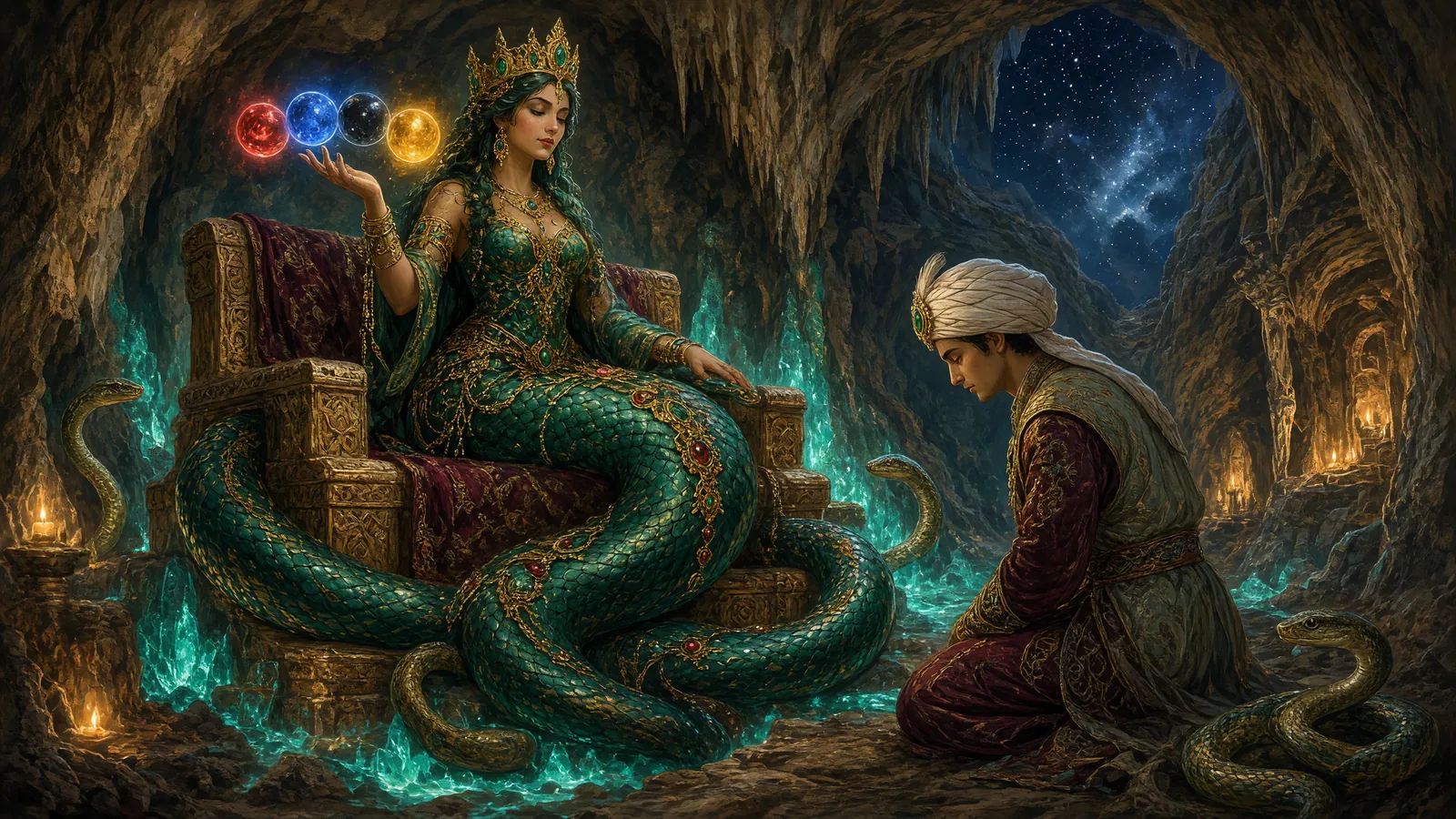
The stairway ended in a great cave. In the middle of the cave lay a lake fed by an underground river; in the middle of the lake, an island; and on the island, a throne carved out of stone. All around were serpents: small ones, large ones, white ones, green ones, golden ones. Not one of them hissed, not one of them struck. All of them had turned toward the throne and were waiting in silence.
On the throne sat Şahmeran.
From the waist up she was a woman: beautiful, dignified, her face as serene as moonlight. Her hair was dark and long, with golden chains braided into it. On her head she wore a crown of gold made of serpents twined about one another, and at its center an emerald glowed. From the waist down she was a serpent: emerald green, jewelled, so long that it wound seven times around the throne and trailed down into the waters of the lake.
Aybars did not know what to do. Then he remembered Sina Hoca's advice: Do not stand stiff before Şahmeran, but do not grovel either. Sit like a respectful guest. He came to the shore of the lake, knelt, and placed his hand upon his chest.
"Peace be upon you, queen of the serpents. I have come from the north, by a long road. Forgive me if I have disturbed you."
Şahmeran opened her eyes. Her eyes were two green wells.
"You have not disturbed me, Aybars." Her voice was like water striking stone. "I have been waiting for you. On the night the stake of heaven wept, my serpents brought me the news. I wondered who would find it. A king, a warrior, a merchant? You came. An orphan. Good."
"Good?"
"Whoever knows what loneliness is also knows what companionship is. The one whose belly is full does not know the worth of bread."
A secret is not given, it is told
Aybars told her his trouble. The stone, the four colors, all that Sina Hoca had said. Şahmeran listened. As he spoke, Aybars noticed that the serpents gliding over the lake were slowly drawing nearer, coming ashore, and forming a ring around him. Asena did not growl. Like the serpents, she had sat down to listen.
"You want the secret of the colors," Şahmeran said at last.
"Yes."
"I cannot give it."
Aybars's face fell. Şahmeran smiled; it was the calm smile of a woman, yet for an instant her teeth gleamed like a serpent's fangs.
"I said I cannot give the secret. A secret does not pass from hand to hand like a purse of gold. If it does, it stops being a secret and becomes gossip. But I can tell it to you. If you understand what I tell you, the secret will be yours. If you do not, you will have listened to a tale; and that is no small thing either."
She dipped the tip of her tail into the water of the lake. The water rippled. And on its surface, as on the face of a mirror, images began to appear.
The first color: Red
"Look," said Şahmeran.
In the water Aybars saw a hearth. In the depths of winter, in a village house, a crimson fire was burning. Around the fire sat a family: a grandfather, a grandmother, a mother, a father, three children. Outside a blizzard howled, but inside everyone was laughing. The grandmother was telling a tale, and the children listened open-mouthed.
"Red is the color of flame," said Şahmeran. "Of fire. But fire not for burning; for warming. The more people sit around a fire, the more beautifully it burns; you have learned this, have you not? With Umay's ember."
Aybars nodded.
"Red is the place where people warm one another. If you want the red of the stone not to flee when it is carved, you must show it a hearth. Let the red tiles remember the fire that people gather around."
The second color: Blue
The water rippled. The image changed. Aybars saw a desert, a blazing sun, a caravan whose lips were cracked with thirst. And before the caravan, a well. At the well stood a woman, drawing water bucket after bucket and handing it out to everyone. Known or unknown, friend or stranger. Asking no one who they were.
"Blue is the color of water," said Şahmeran. "No one can keep water for himself, Aybars. You cup it in your palm and it runs between your fingers. Water gives life only when it is shared. If you let seven people drink from one jug of water, all seven will live. If you drink it alone, you will not live either; for whoever is left alone in the desert is already dead."
"Let the blue tiles," Aybars said slowly, "remember the water that is shared."
For a moment Şahmeran's eyes gleamed. "You are learning."
The third color: Black
The image changed again. A field. Black, wet, fertile earth. Upon it, many people; one plowing, one sowing, one watering, one reaping. None of them did anything alone; each took up the work of the one before and passed it on to the one after. And in the end, on the threshing floor, a heap of wheat rose high.
"Black is the color of earth," said Şahmeran. "Everyone walks on the same earth. The king and the beggar alike. The earth does not ask who is who; it gives the harvest to whoever sowed the seed. But no one can plow a field alone. The earth makes people work in turn. One finishes, another begins. A turn comes, a turn passes."
Aybars thought about this. "Turns," he said. "At a table there are turns too. Everyone plays when their turn comes."
This time Şahmeran laughed. She truly laughed; her voice echoed through the cave, and every serpent raised its head. "The Hoca has taught you well. Or the road has. Let the black tiles remember the earth that is worked in turn. Let no one miss their turn, and let no one steal another's."
The fourth color: Yellow
The last image was a morning. In the middle of the steppe, a world just come out of darkness. And on the horizon, a sun was rising. As it rose, its light touched everything at the same moment: the palace and the hut, the wolf's den and the bird's nest. Asking no one, wanting nothing from anyone.
"Yellow is the color of day. Of the sun." Şahmeran's voice softened. "This is the hardest one, Aybars. The sun rises for everyone, but not everyone sees it. Some draw their curtains. Some begrudge that the sun rises for their neighbor too. The sun is hope. A promise that the night will end, that the darkness will pass, that tomorrow people will sit down at the table again."
For a long time Aybars did not speak. Then he said slowly:
"Fire, water, earth, sun. Warming, sharing, waiting your turn, hoping." He paused. "These are the four sides of a table."
Şahmeran leaned forward from her throne. Her serpent's tail stirred waves in the water of the lake.
"Now you understand. This is the secret. The colors sleep inside the stone because everyone who found the stone wanted them for himself. The red for his own fire, the blue for his own jug, the black for his own field, the yellow for his own hope. The colors took offense, and fell asleep. You will wake them in order to share them. When you carve the stone, if they ask you to whom each color belongs, let your answer be this: to the table. To everyone who sits at the table."
Four orbs
Şahmeran opened her hands. In her palms appeared four orbs: red, blue, black and yellow. They were not light, yet they shone like light. Each orb thrummed with a sound: the crackle of a hearth, the splash of a well, a plowshare sinking into the earth, a rooster's morning crow.
"These are the waking sounds of the colors," said Şahmeran. "Take them to Sina. As you carve the stone, whenever a color wakes, set the matching orb beside it. The color will hear its own sound and will not flee. It will settle into its place."
She put the orbs into a silk pouch, and a serpent tied the mouth of the pouch shut: a tiny, golden serpent that bit its own tail and became a knot.
"This serpent guards the pouch. No one can open it until you return. When Sina opens it, the serpent will come back to me."
Aybars placed the pouch against his chest, beside the stone. When the two touched, the stone trembled faintly, as if it had been reunited with kin it had not seen in a very long time.
"How can I ever thank you?" he asked.
Şahmeran leaned back on her throne. For a moment her eyes looked very tired, and very old.
"My story is a bitter one, Aybars. Once I trusted people; I told my secret to a friend. That friend sold my secret to a king, and the king had me hunted. Since that day I have been here, beneath the earth. I speak with no one but my serpents." She was silent for a while. "Do one thing for me: when you set up that table, if one day a stranger comes and asks you for a seat, make room without asking his name. Once, no one made room for me. At your table, let there be room for everyone."
"I promise," said Aybars.
Şahmeran closed her eyes. One by one, the serpents began to put out their light. The cave grew dark. Aybars and Asena walked toward the stairway, hearing Şahmeran's last words behind them:
"And give my greetings to the queen of the birds. She is very lonely on Kaf, too."
Above
When they came up the stairs, dawn had broken. Akyel was dozing beneath the fig trees. All around him on the ground lay figs, unbruised, unpicked, lying neatly where they had fallen. The tulpar had not touched a single one.
Aybars threw his arms around him. "Well done," he said. Then he took one of the dried figs from the pouch and fed it to him. "This one is the Hoca's. But we owe it to you."
That evening, when Hasan Efendi counted the figs in the pouch, he would notice that one was missing, and after hearing the whole story he would write this line in his ledger: One fig, for the patience of a tulpar. A fair price.
But that would be much later. For now, before Aybars stood the highest mountain in the world. And on its summit, waiting for Şahmeran's greeting, the queen of all the birds.