Those who see Konstantiniyye for the first time believe the city has risen out of the sea. So did Aybars. When Akyel carried him to the top of the last hill, he saw before him a blue strait, and on either shore thousands of houses, palaces, towers and gardens climbing the slopes. Gulls were crying, ships' sails were filling with wind, and the ringing of bells and the call to prayer and the cries of the hawkers all mingled together. For a young man who had come from the silent lakes of the north, the sound was like a wall. But not a cruel wall; a wall that, once you passed through it, let you into a warm room.
And in the middle of the city, above everything, was the dome.
Aybars had never seen anything like it in his life. A sky made of stone. It had been built hundreds of years before; as Mother Umay had said, people had wanted to bring the sky down to earth. The dome shone like gold in the evening sun, and pigeons wheeled around it. Whoever stood beneath it and looked up felt as if they were truly standing beneath the heavens; but this heaven had been made by human hands, and it did not crush a person, it embraced them.
Aybars climbed down from the horse and gazed for a long time. Then he noticed that the stone above his heart was beating faster than ever. The stone seemed to recognize the dome.
The house in the shadow of the dome
Finding Sina Hoca was not hard. Everyone in the city knew him. A fisherman said, "The Hoca? Turn right at the fountain on the west side of the dome, the door with the purple bougainvillea." A baker said, "Sina the physician? Ah, last winter he brought down my daughter's fever, God bless him. At the end of the booksellers' street." A child said, "Grandpa Star? The grandpa who sits on his roof at night looking at the sky? Come, I'll take you," and took Aybars by the hand.
The child led him down a narrow, stone-paved lane. At the end of the lane, exactly where the long shadow of the dome came to its tip, stood a two-storey wooden house. Purple bougainvillea had wrapped itself around the door. Above the door hung a sign that said the same thing in three languages:
Knowledge belongs to the one who knocks.
Aybars knocked.
The man who opened the door wore a red fez, had a white beard and round spectacles, held a reed pen in his hand, and had ink-stained fingers. He looked over his spectacles at Aybars, at the wolf behind him, and at the winged horse behind them both. For a moment his eyebrows climbed to the middle of his forehead, then settled back into place.
"You were looking for the Hoca? Come in. The wolf may come in too, so long as she stays off the carpet. The horse... please tie the horse in the garden, and don't let him touch the figs; the Hoca is very fond of his figs."
This was Hasan Efendi. Sina Hoca's scribe, assistant, cook, bookkeeper and, in his own words, "the memory of the house." For years he had written down everything the master said and never once read any of it again, because he never forgot anything he had written. Yet for some reason he could never remember where he had put his spectacles. At that moment they were on his forehead.
Sina Hoca
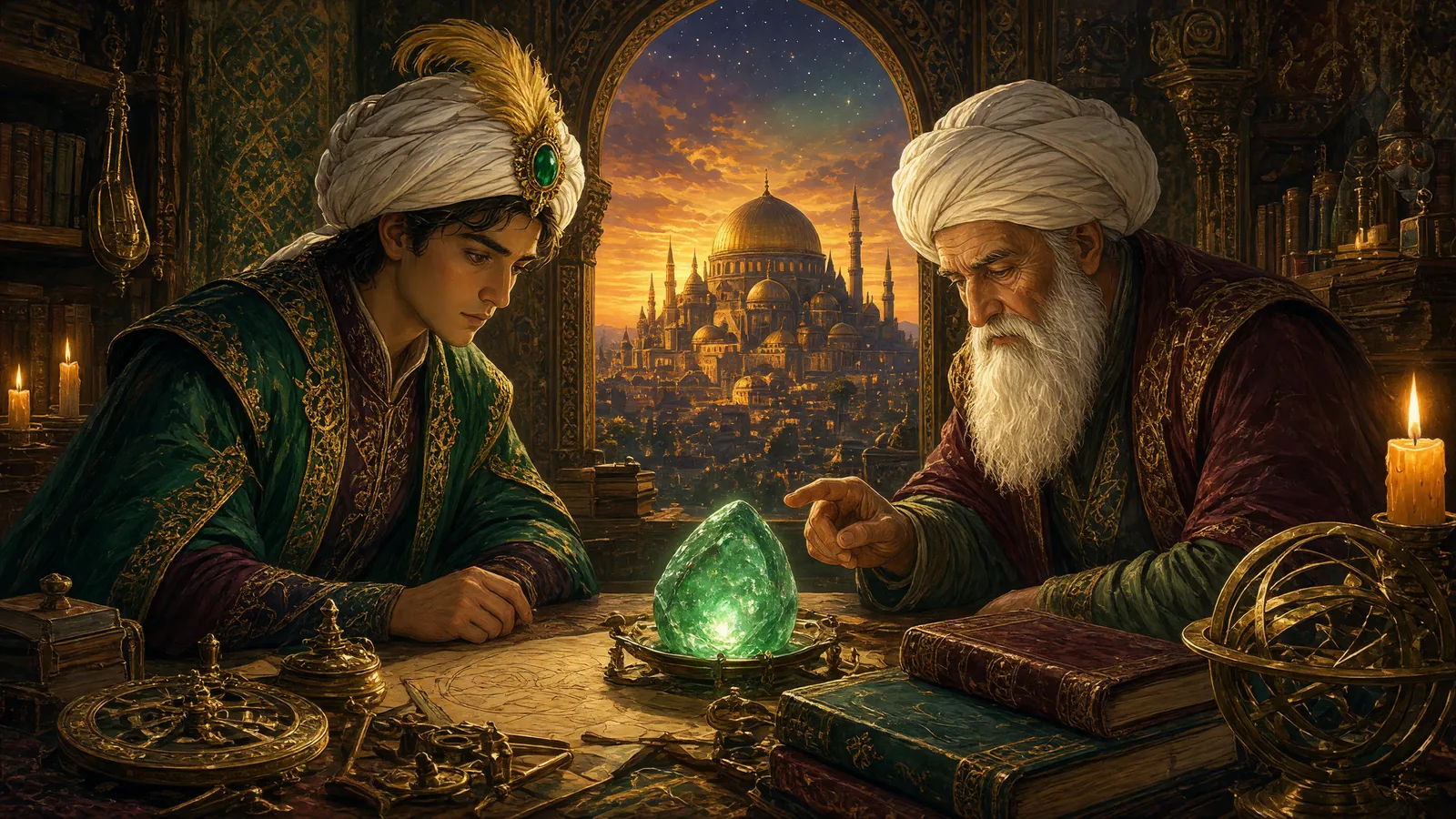
Sina Hoca's study was the strangest place Aybars had ever seen. Every wall was lined with books up to the ceiling. Wedged between the books were jars of dried herbs and colored powders, and in one jar something that moved in a peculiar way. On the table stood brass astrolabes, celestial globes, the hand bones of a human skeleton, an unfinished game of chess, three separate coffee cups and a plate of figs. Models of the planets hung from the ceiling on strings, turning slowly in the breeze from the window.
The Hoca stood at the window. He was an old man, thin and tall. His beard came down to his chest, his turban was snow-white, his robe the blue of night. He held an astrolabe, aimed out of the window toward the dome, measuring something. When Aybars came in, he did not turn around.
"You have come from the north," he said. "The mud on your boots is the earth of the Red Ridges. There are ice crystals in the wolf's fur, so you passed beside the glacier. There is a hundred-year-old mark of ice on one of your horse's wings, so it was you who freed him. And inside your kaftan, just over your heart, you carry something that is driving every compass in my room mad."
Only then did he turn. His eyes were the keenest Aybars had ever seen; but there was no hardness in their keenness. It was more like the way a light can show you everything and burn nothing.
"Let me see it, then, child of the Iron Stake."
Aybars took out the stone and set it on the table. At once every compass needle in the room swung round to point at it. The planet models on the ceiling swayed. The strange thing in the jar stopped moving. Hasan Efendi dropped his pen.
For a long while Sina Hoca said nothing at all. He put on his spectacles, took them off, picked up a magnifying glass, set it down. He did not touch the stone. He only bent and looked, and looked, and looked. Then he straightened, and a strange silence fell over the room.
"For forty years I have watched the sky," he said at last. "One night, years ago, I saw one corner of the Iron Stake go dark for a moment. I told no one, because no one would have believed me. I did not even tell Hasan."
"You did not," said Hasan Efendi, picking his pen up off the floor. "If you had, I would have written it down."
"So this is what fell." The Hoca moved his finger over the stone without touching it. "A tear."
Three things
That night they talked for a long time. Hasan Efendi made a pot of lentil soup, toasted bread, and laid out figs. He set four plates on the table. Asena had a plate too, with a lamb bone in it. Akyel slept in the garden without touching the figs.
Aybars told them everything: his father, the empty table, the night on the mountain, Mother Umay, the shadow, the tulpar, the traveler beneath the mulberry tree. Sina Hoca listened, nodding now and then, asking a question or two. Hasan Efendi wrote it all down.
When Aybars had finished, the Hoca leaned back in his chair.
"Mother Umay told you the truth. This stone cannot be carved with iron. But when she said 'patience, light and companionship,' she was not reciting poetry; she was giving you a recipe. The way a cook says 'a pinch of salt.' Let me tell you the rest of the recipe."
He spread a sheet of paper on the table, drew a circle on it with his pen, and divided the circle into four.
"There are four colors inside the stone. You have seen them. But these colors are sleeping. The moment we begin to carve the stone, they will wake. A color that wakes and cannot find its place will flee, and the stone will become an ordinary lump of rock. There is only one being who knows the secret of keeping the colors in their places: the queen of the serpents, Şahmeran. She lives in the caves beneath Tarsus. She knows the secret of every herb, every stone, every color. But she gives her secret to no one; she only tells it, to one who deserves it."
He drew a line through the middle of the circle.
"Second, the blade. Not iron, we said. Then what? Light. But not candlelight, not even sunlight. What we need is the light of knowledge; and there is only one being in the world who has turned knowledge into light: the queen of all the birds, who dwells on the summit of Mount Kaf, Zümrüdüanka. A single feather of hers shines in the dark and shows the inside of whatever it touches. With that feather we shall carve the stone."
At the edge of the paper he drew a heart.
"The third..." He paused, and smiled. "The third is with me. Or with you. Or with Hasan. Or with whoever crosses your path along the way. Companionship is not an ingredient, my child. It is a place. Like this table. It forms when people sit down and scatters when they rise. As long as you have friends sitting around you while you carve the stone, that is enough."
Aybars looked at the paper. A serpent, a bird, a table.
"And you, my Hoca? Why are you helping me? I have not even asked you for anything."
Sina Hoca laughed. His laughter seemed to rustle the pages of every book in the room.
"I told you, I have watched the sky for forty years. Do you know why? I was searching for something up there. I did not know what. Now I know." He pointed at the stone. "A reason. So that an old man who sits alone might have something to say to whoever knocks at his door. If we carve this stone, Aybars, you will not be doing it for yourself. Nor will I be doing it for myself. And then we shall both have won."
Hasan Efendi underlined the last line he had written.
Preparing for the road
The next morning Sina Hoca gave Aybars three things. The first was a map: the road to Tarsus, with the mouth of the caves marked on it. The second was a manuscript: an old traveler's notes on Mount Kaf, half of them illegible. The third was a pouch of dried figs.
"The figs are important to me," said the Hoca with a serious face. "Eat them when you get hungry on the road. When you come back, I will count how many are left."
"He won't," whispered Hasan Efendi, leaning toward Aybars's ear. "But I will."
Aybars wanted to leave the stone with the Hoca, but the Hoca would not accept it.
"Let the stone stay with you. It chose you. Şahmeran will not tell her secret without seeing it, and Zümrüdüanka will not give her feather without seeing it. I will prepare the fire here, think about the racks, work out the numbers. When you return, we will begin."
Aybars mounted Akyel. Asena came to his side. At the door, Sina Hoca and Hasan Efendi waved. The shadow of the dome lengthened and painted the stones of the lane.
As Aybars flew over the city toward the southeast, toward the Taurus Mountains, he turned once to look back. The dome shone in the morning sun like a piece of the sky. And the stone above his heart, for the first time, beat with the calm of someone who knows he is not alone.