
The southern road ran first through forest, then across the steppe, and then over the bare, wind-scoured hills that people called the Red Ridges. Aybars walked for twelve days. His feet blistered, his lips cracked, and the bread in his saddlebag grew hard as stone. Every evening Asena found a hare or a partridge somewhere and laid it before the young man, then rested her head between her paws and watched the fire.
The fire... From the very first night Aybars understood what Mother Umay's warning had meant. The fire he kindled with the hearth ember stayed as small as a candle flame whenever he sat beside it alone, warm enough only to warm his hands. But when Asena came and lay down beside him, the flame rose a hand's breadth higher. So even a wolf counted. Aybars laughed at that, and from that night on he called the wolf "my companion."
Beyond the Red Ridges
On the thirteenth day they came to the foot of a glacier. It was a glacier that never melted, not even at midsummer; the old folk called it "the mountain's heart of ice." It climbed toward the sky in layers of blue, green and white, and here and there water seeped from its cracks. Caravan drivers went the long way around it and never came near, for it was said that at night a horse could be heard neighing from inside the ice.
That night Aybars heard it too.
It was a long neigh, full of pain, and yet just as full of pride. It sounded less like a horse than like a voice summoning an army. Asena pricked up her ears and set off running toward the glacier. Aybars lit a torch and followed her.
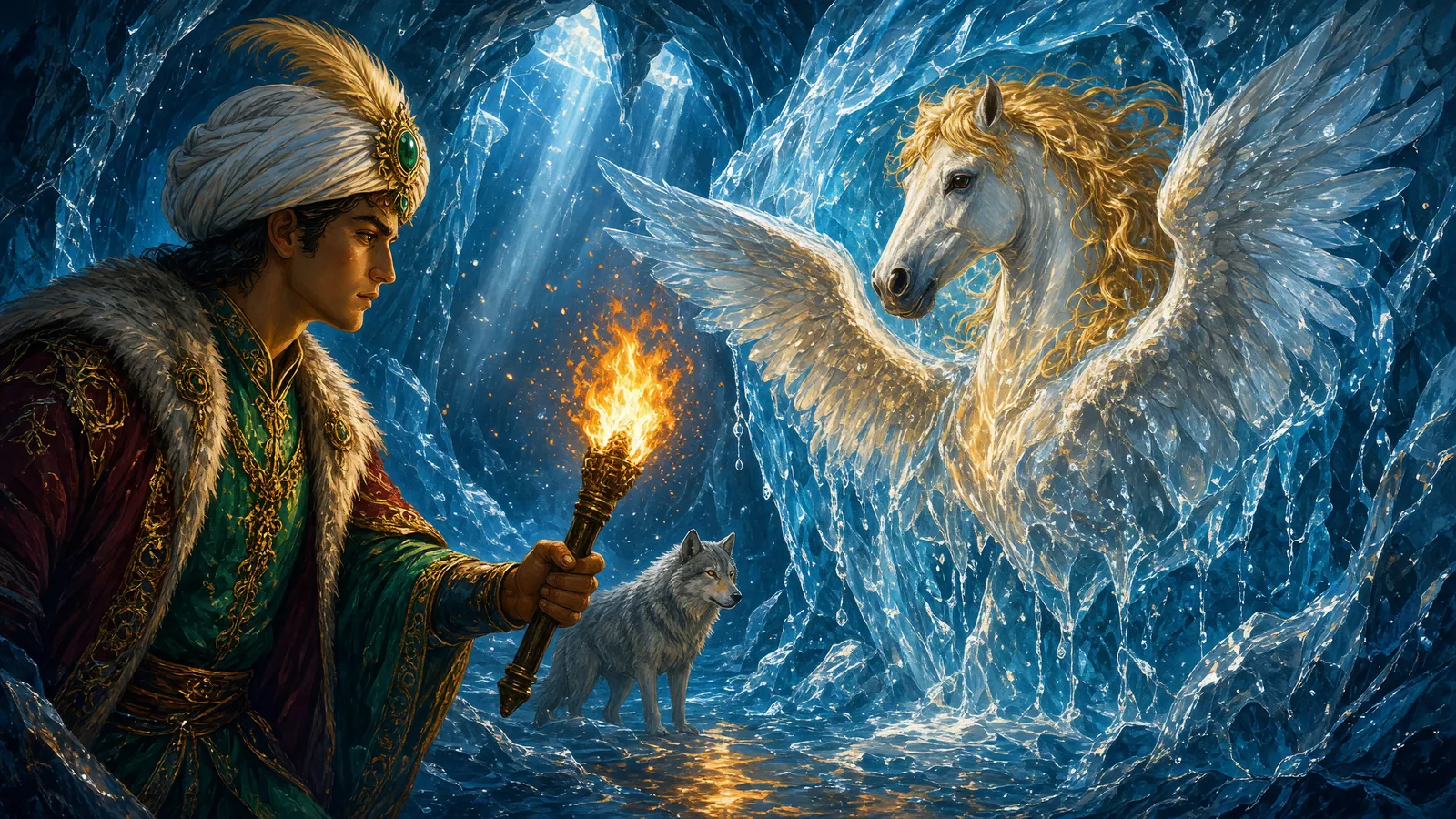
At the foot of the glacier there was a narrow cave mouth. Inside, everything glowed with a deep blue light, as though the ice made its own. The walls were clear as glass, and icicles hung from the roof like strings of pearls. And in the deepest part of the cave, inside the ice, there was a horse.
A horse as white as snow. Its mane and tail were the color of gold, its hooves shone like silver. But what took Aybars's breath away was on the horse's back: two wings. Broad as an eagle's, feathered, white and gold. One wing had frozen half open; the other was still folded against its body. The horse's eyes were open. And it was alive. From inside the ice, it was looking at Aybars.
"Tulpar," Aybars whispered.
The grandfathers used to tell of it: long ago, heroes had winged horses. They flew over the seas, cleared mountains in a single leap, and heard their masters' voices from seven days away. They were called tulpars. But the tulpars had vanished long since, and the grandfathers who told of them were themselves the grandchildren of the last grandfathers who had seen one.
The story of the ice
Aybars laid his hand on the ice. It was not as cold as he had expected. It was more like something no one had touched for a very long time: neither warm nor cold, only forgotten.
And for a moment, beneath his palm, he felt a story. Perhaps because the Star Stone lay over his heart, perhaps because Mother Umay's ember burned in his hand. The story came to him in pictures:
This tulpar's name was Akyel. A hundred years ago a khan had owned him. Upon Akyel's back the khan had won wars and conquered lands. But he had shared not one of his victories with anyone. He had locked his plunder in chests, buried the chests in the mountains, and told no one where. In the end, giving ear to Erlik's whisper, he had wished to hide his greatest treasure too, which was Akyel. "Let this horse carry no one but me," he had said. "And when I die, let him carry no one at all."
Erlik had granted that wish gladly. When the khan died, he sealed Akyel inside the ice, "so that he may serve no one but his master." And for a hundred years the tulpar had waited there, because of one master's selfishness, unable to spread his wings, never to see the sky again.
Aybars drew back his hand. His eyes had filled with tears.
"No one is going to own you," he told the horse in the ice. "Not even me. But if I get you out of here, you can go wherever you wish. If you like, you can come with me. If you like, you can fly into the sky. The choice is yours."
Something stirred in the horse's eyes.
Ember and ice
First Aybars tried the torch. The flame touched the ice, but the ice did not melt; the torch hissed and went out. He tried to scrape at it with his knife; the tip of the blade snapped. Asena dug at it with her paws, and the ice did not take so much as a scratch. This was Erlik's ice. Iron, fire and strength could not break it.
Then Aybars remembered the ember in his palm. This fire warms only when more than one sits beside it.
He built a fire in the middle of the cave. Carefully he set the ember among some dry moss. The fire caught, small and dim. Aybars sat down beside it. Asena sat on the other side. The flame rose a hand's breadth. But that was not enough to melt the ice.
Aybars thought for a while. Then he stood, crossed to face the horse in the ice, and began to speak aloud. He told Akyel about his father. About the table with forty chairs. About the cook in the kitchen, the groom in the stable, the guard at the gate. About the extra bread the steward had slipped into his saddlebag. About the hares Asena brought him every evening. About Mother Umay's smile. He told and told, midnight came and went, his voice grew hoarse, but he did not stop. Because he had noticed something: the more he spoke, the bigger the fire grew.
Akyel was listening from inside the ice. And as he listened, he too was taking a seat at the table.
The flame rose a man's height. Then twice a man's height. The blue light of the cave turned orange. The ice began to sweat, drop by drop, then drip by drip, then in running trickles. Akyel's half-open wing trembled. One hoof came free of the ice. Then another.
And at dawn, as the last icicle broke from the cave roof and fell to the floor, the snow-white tulpar stepped out of the ice, spread both wings at once, and neighed so loudly that the mountains rang. The wind of his opening wings put out the fire, but it was no longer needed. The sun was rising.
Akyel stopped before Aybars. He bowed his head and pressed his muzzle to the young man's chest, right where the Star Stone lay. Aybars laid a hand on the horse's neck.
"Will you come with me?"
For answer, the tulpar knelt and offered his back.
The traveler at the crossroads
Travelling on Akyel's back was something else entirely. The tulpar did not fly, but he ran with such long strides that every stride cleared a hill. Asena ran beside them like a shadow and never fell behind. In three days they covered a month's journey.
On the evening of the third day they came to a place where four roads met. The road from the north, the road to the south, and two roads coming and going from east and west. In the middle of the crossroads stood an old mulberry tree, and at its foot sat a traveler.
The traveler was very old. His beard was white as snow, he was wrapped in a green cloak, and in his hand he held a knotted staff. His shoes were torn, his cloak patched. Before him there was no fire, no saddlebag, no water skin. When he saw Aybars he smiled, but he asked for nothing.
Aybars got down from the horse. He looked in his saddlebag: two pieces of bread were left, and a little dried curd. It was not enough even for himself, and Konstantiniyye was still weeks away. For a moment he hesitated. Then he broke one of the loaves in two and held out the larger piece to the old man.
"Here, father. May your road be blessed."
The old man took the bread, smelled it, and ate it slowly, savoring every bite. Then he looked at Aybars, and in his eyes there shone a light far younger than his years.
"He who shares his bread before he eats shortens his road, my son," he said. "Let me give you something too. Not like bread, though; like a riddle. Bread fills the belly, a riddle fills the head."
Aybars lit the fire. This time there were three of them, and a tulpar besides. The flame leapt up to the sky.
The old man held his hands to the fire and said:
"There is a stone that can be any stone.
If it wants red, it is red; if it wants blue, it is blue.
If it wants seven, it is seven; if it wants thirteen, it is thirteen.
It fills the place of whatever is missing, yet yields its own place to no one.
Tell me, then: what is this stone called?"
Aybars thought long and hard. He thought until morning. He found no answer.
When he woke at dawn, the old man was gone. At the foot of the mulberry tree only two things remained of him: the print of a green cloak in the flattened grass, and on one of the tree's withered branches, in the dead of winter, a single white flower in bloom.
Asena sniffed the flower and wagged her tail. Akyel neighed. As for Aybars, he did not yet know who the old man was, but he knew he would not forget him until he had found the answer to the riddle.
They turned south. On the horizon, beyond the morning mist, the domes of a city were beginning to appear.