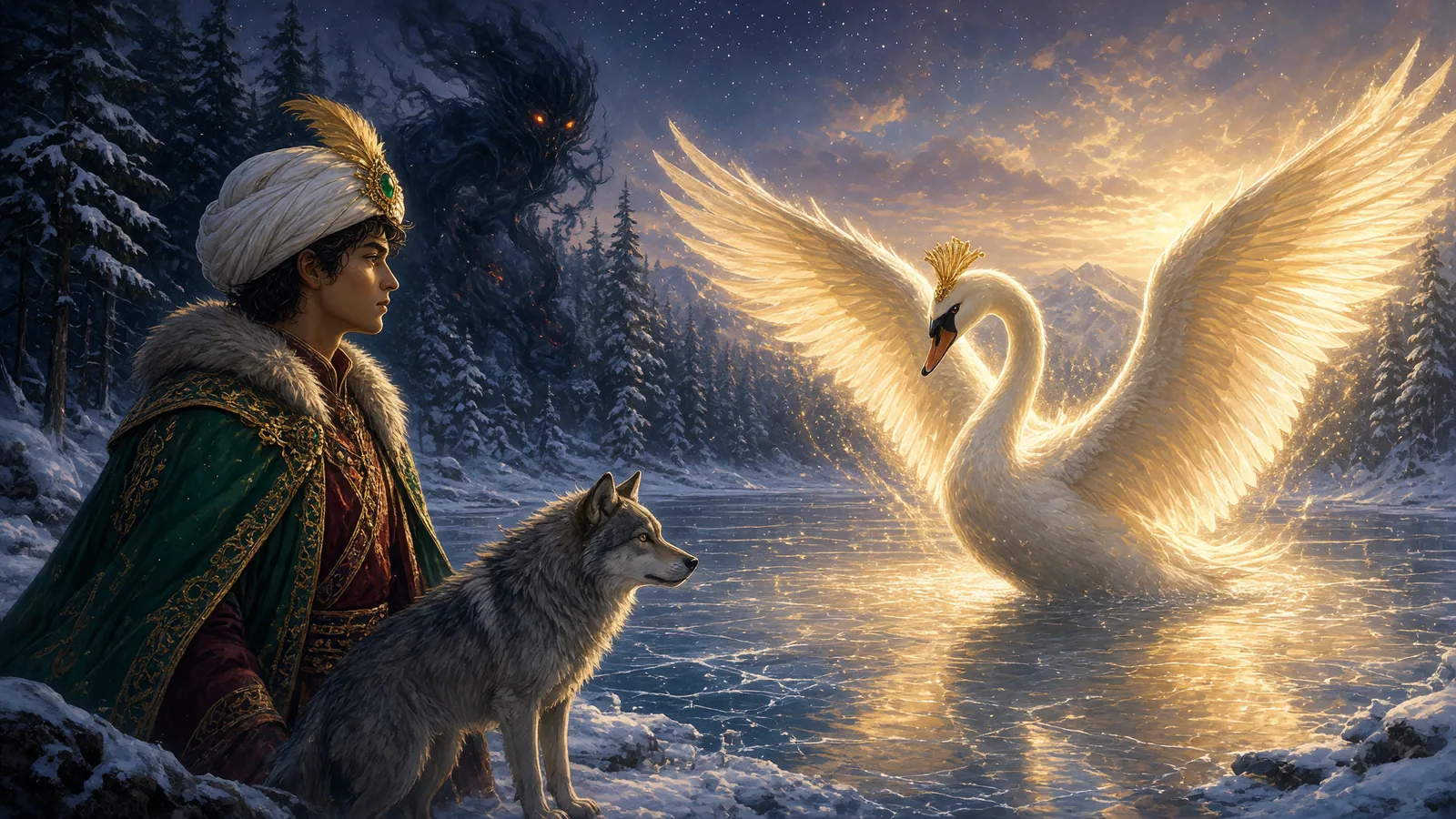
The frozen lake was called the Silent Lake. The fishermen had given it that name, because in winter, when it iced over, even the footsteps of someone walking on it were swallowed. The lake lay at the edge of the principality, where the pine forest ended, flat as a mirror and white as snow. When Aybars reached it, the sun had only just risen above the trees, and the ice glowed with a rosy light.
The swan was in the middle of the lake.
From afar it looked like an ordinary swan, perhaps a little large. But as Aybars drew nearer he saw that the bird stood almost as tall as a horse, that the white of its feathers was brighter even than snow, and that above its head hung a halo of golden light. The swan was not walking, nor was it swimming; it stood a hand's breadth above the ice, as though it had no weight at all.
Asena stopped at the shore and bowed her head. It was the first time Aybars had seen the wolf bow to anything.
Mother of the hearth
"Come closer, son of Kara Toğrul," said the swan.
Her voice was like a lullaby a mother sings to the child in the cradle: soft, but admitting no objection. Aybars stepped onto the ice. His footsteps were swallowed. Ten paces from the swan he knelt. No one had ever taught him to, but his knees bent of their own accord.
"Do you know me?" asked the swan.
Aybars remembered what his grandmother had told him. There was a mother who guarded babies in their cradles, who held women's hands in childbirth, who opened roads for travelers, who kept watch through the night so the hearths would not go out. She took the form of birds, and most often she became a white swan. When his grandmother spoke her name, she would lower her voice:
"Umay Ana," said Aybars.
The swan bowed her head, and in that moment her feathers turned to light. The light lengthened and took the shape of a woman: of no age one could tell, her face both young and ancient, clothed in white, a cloak of swan feathers on her shoulders, a fine golden crescent upon her brow. In her hand she held a small lantern. Inside the lantern burned a hearth fire, as if taken from the reddest embers of a stove.
"I knew you as a child," said Umay Ana. "When you listened to tales on the cook's knee in the kitchen. When you groomed horses beside the stableman in the stable. When you warmed your cold hands at the guard's fire. As your father's table narrowed, your table grew wider, Aybars. You did not notice. I did."
The young man did not know what to say. Inside his kaftan the stone suddenly grew warm, as if it were listening to what was said.
"Show me," said Umay Ana.
The secret of the stone
Aybars took out the stone. Umay Ana did not take it; she only held her lantern over it. When the lantern's light struck the stone, the four colors inside came alive, turned, and danced around one another.
"This is the tear of the Iron Stake," said Umay Ana. "The star wept on a night when people had forgotten how to go as guests to one another's hearths. A tear carries a star's wish. And that wish is this: let people gather once more around a table."
"But it is a stone," said Aybars. "How can a stone become a table?"
Umay Ana smiled. "By being carved. Every stone hides a shape within it, my son. And within this stone there are hundreds of little stones. Each of them means nothing on its own, but side by side they take on meaning. One, alone, is a seven; set an eight and a nine beside it, and it becomes a run. One, alone, is a red; set a blue and a black beside it, and it becomes a family. Like people. Alone, everyone is a number. Side by side, they become a story."
Aybars did not fully understand this, but he felt something inside him settle into its place.
"Who will carve it?" he asked.
"It is not carved with iron," said Umay Ana. "Iron is Erlik's metal; the sword, the chain and the lock are all his making. If iron touches this stone, the colors within will turn their faces away. Only three things can carve it: patience, light and companionship. Patience you will bring. Light you will find on the road. And companionship..." She paused and looked at Aybars for a long while. "Companionship you will build with those you meet along the way. You cannot do this work alone. Indeed, the whole meaning of this stone is that it cannot be done alone."
"Where must I go?"
Umay Ana turned her lantern to the south, beyond the horizon.
"To the city where earth and sky meet. There, people built a dome to bring the sky down to the earth; so great that whoever stands beneath it feels the heavens are right above their own head. In the shadow of that dome lives a master who gathers knowledge the way one gathers light. His name is Sina. He reads stones, stars, the human body and the human heart. No one but he can unlock the secret of your stone."
"Konstantiniyye," whispered Aybars. He had heard the name from caravan men. It sounded like the other end of the world.
"Konstantiniyye," said Umay Ana. "A long road. But you will not go alone." She turned her eyes to the wolf standing with bowed neck on the shore. "Asena will go with you. Further on, there is another friend waiting for you, inside the ice. And at a crossroads, a traveler with whom you will share your bread."
The shadow attacks
Just then, a shadow fell across the lake.
The sun was still in the sky, but its light faded all at once, as if someone had drawn a dirty veil before it. A black smoke spilled from the pine forest. Creeping along the ground, coiling, it spread out over the ice. Within it glowed two embers, like two eyes. Where the smoke passed, the ice cracked and the snow turned gray. And that cold smell came again: the ashes of a dead hearth.
"Erlik's shadow," said Umay Ana in a calm voice. "Do not call it by its name. A shadow called by its name grows."
The smoke spoke. Its voice was like footsteps echoing in an empty hall:
"Give me the stone, young lord. I will make you rich. I will fill your father's forty-chaired hall with gold. You will never need anyone again. No one will knock at your door, no one will ask for a share of your bread. I will give you peace."
Aybars hesitated for a moment. I must admit it: for a moment. Because what the shadow said seemed, in one way, to be true. To need no one. For no one to knock at the door. But then his father's last words rang in his ears: What I gathered was silence.
"Your peace," said Aybars, and he himself was amazed that his voice did not tremble, "is my father's table. Forty chairs, a single plate. I have seen it. I do not want it."
The smoke swelled in rage, rose over the ice like a wave, and hurled itself at the young man.
Asena moved first. The wolf shot forward like an arrow and plunged into the smoke. Her teeth did not pierce the smoke, but her presence did; the smoke drew back, hissing. Then Umay Ana raised her lantern. The light that spread from it scattered over the lake like the morning sun. Wherever the shadow touched the light it melted, turned to vapour, and fled shrieking into the forest. The gray snow turned white again. The cracked ice closed over of its own accord.
The silence returned. But this time it was a sweet silence, like the coolness that pours in when you open a window after a storm.
The ember from the lantern
Umay Ana was becoming a swan again. As her feathers turned from light back to white, she held out one last thing to Aybars: a small ember from the fire in the lantern. The ember drifted through the air and settled in the young man's palm, and it did not burn him.
"This is a hearth ember," said Umay Ana. "Wherever you go, you can kindle a fire with it. But take care: this fire warms only when more than one person sits beside it. Kindled alone, it stays dim. If you wish to test the fire, call a stranger to sit by it."
And the swan spread her wings. No wind rose, yet the snowflakes swirled into the air and glittered like gold in the light. The swan rose, and rose, and flew toward the place of the Iron Stake, beneath the star that cannot be seen by day, and vanished from sight.
Aybars turned back to the shore. Asena came to him, pressed her nose to the ember in his palm, and sneezed. Aybars laughed. It was the first time he had laughed since his father died.
That day he returned to his principality. He summoned the steward and entrusted the realm to him. "If I do not come back," he said, "do not leave the table in the hall with forty empty chairs. Every evening, invite one of the villagers to the table. Let the chairs be full, even if the plates stay empty."
His eyes brimming, the steward nodded.
The next morning Aybars set out to the south with a saddlebag of bread, a skin of kumis, a hearth ember in his palm, a star stone over his heart, and a gray wolf at his heels. He had left his lame horse with the steward. He would go on foot, until the "friend waiting inside the ice" of whom Umay Ana had spoken found him.