
In the north, in the lands that lie directly beneath the Iron Stake, there was a small principality. It was so small that mapmakers could not be bothered to draw it, and those who did set down a single dot and moved on, so that it might be mistaken for a blot of ink. On one side were pine forests, on the other frozen lakes, and behind it mountains whose peaks stayed white the whole year round. Its people spoke little and worked hard. Their winters were long, their summers short, and their evenings never seemed to end.
The lord of this principality was an old man named Kara Toğrul, broad and heavy, with a voice like thunder. In his youth he had been famed for his hospitality; forty people would sit at his table, and room would be made for the forty-first who came. But as the years went by, as Erlik's whisper wandered across the steppe, Kara Toğrul's table shrank too. Guests stopped coming. Those who came ate their meal and rose in silence. In the end the old lord began to eat alone in the great hall: at one end of a table set for forty, one plate, one cup, one candle.
Kara Toğrul had a son: Aybars. His grandmother had named him; "let him be bright as the moon, ay, and brave as the leopard, pars," she had said. Aybars was nineteen, slender, with eyes like black grapes and a smile like the winter sun, brief but warm. He loved conversation more than the sword, and tales more than the hunt. As a child he would sit with the cooks in the kitchen, the grooms in the stable, the guards at the gate, and coax a story out of every one of them. His father was angered by this and would say, "A lord does not sit with his people; he stands before them." And Aybars would think to himself: if I do not know the people I stand before, what am I standing before at all?
The empty table
That winter Kara Toğrul died. It was not a long illness; one evening he rose from the meal, sat down before the window, looked out at the mountains, and never rose again. Before he died he spoke one last word to his son. Aybars would turn that word over for years:
"All my life I gathered something, my son. Now I look, and what I gathered was silence."
Few came to the funeral. Those who came left quickly. When Aybars returned to the great hall, he saw that the table was still laid for forty. Out of habit the servants had set out forty plates. The young man sat at one end, and for the first time in his life he heard the sound of loneliness: the hiss of a candle, the wind blowing far away, the beating of his own heart. Nothing else at all.
That night he saw his father in a dream. The old lord was again at the end of the table, but this time the table was endless; it stretched on and on until it melted into the dark. Every chair was empty. His father looked at him and moved his lips, but no sound came. When Aybars woke drenched in sweat, the light of the Iron Stake was falling through the window, and that light seemed a little colder than ever before.
Before morning he saddled his horse. To his steward he said only, "I am going up the mountain." The steward was an old and wise man; he did not ask why the young man was running, only put extra bread, dried curd and a skin of kumis into his saddlebag. Standing at the gate, he called after him:
"Son of the lord, the mountain does not answer a man. But sometimes it teaches him how to ask."
The pass
For three days Aybars wandered the mountains. He did not know what he was looking for. Perhaps nothing; perhaps only a silence greater than the silence of the hall, so that his own grief might seem small. On the fourth day his horse stumbled on a steep slope and twisted its leg. Aybars tied it beside a shepherd's hut and went on walking. The snow had risen to his knees. The wind lashed the end of his turban against his face like a whip.
Toward evening he came to a pass whose name no one knew. Between two giant rocks ran a narrow path, and at the end of the path lay a snow-white plain that opened onto the sky. The sun was setting, scattering purple and gold across the snow. Aybars sank down at the foot of a rock. He was tired, he was cold, and here in the middle of these mountains he realized, for the first time, that he wanted to go home. But what home was there to go back to? An empty hall with forty chairs?
It was just then that he saw the wolf.
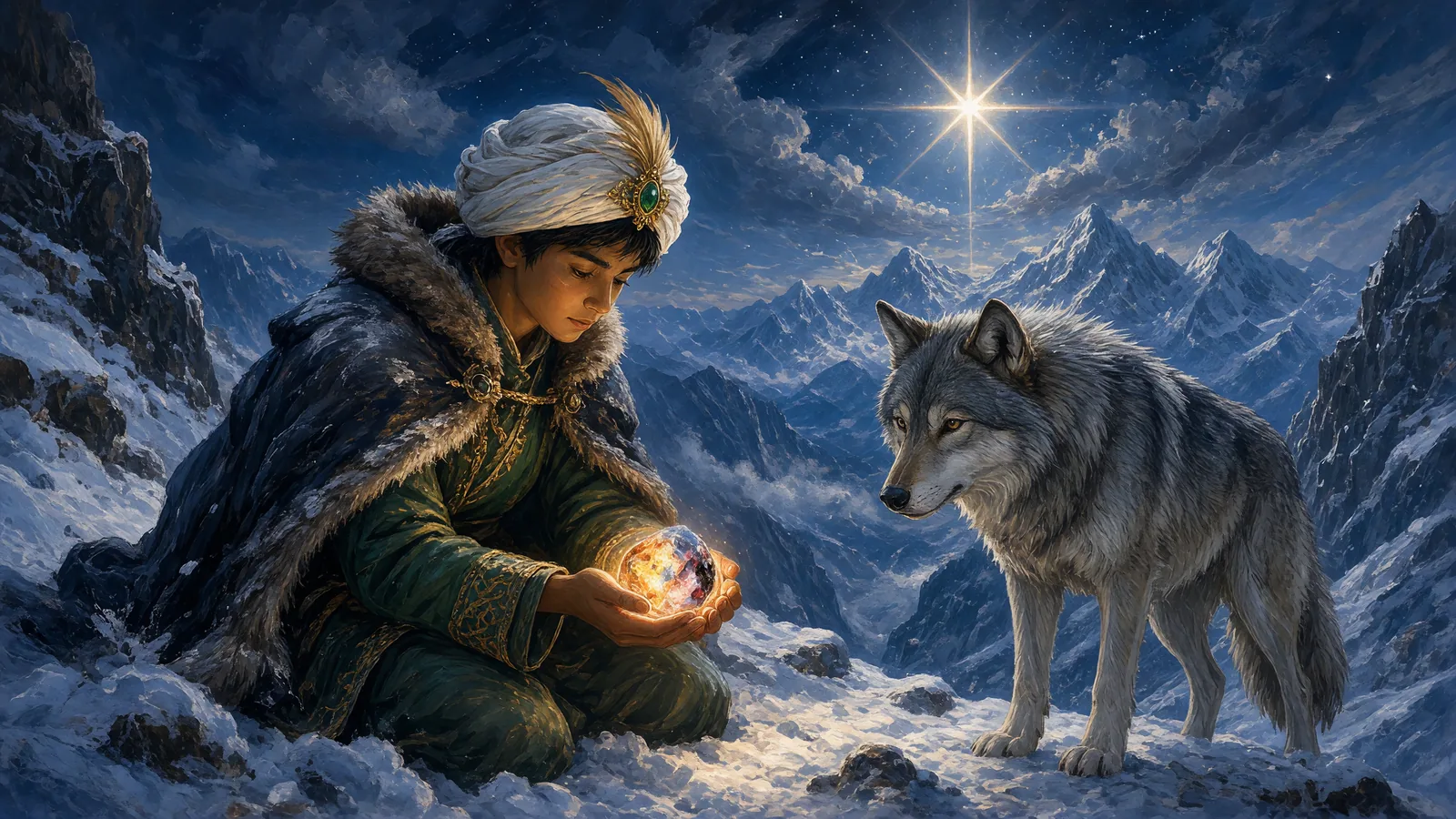
On top of the rock, as though it had always been there, stood a great gray she-wolf. Her fur shimmered toward silver, and her eyes glowed like amber warmed in a fire. Aybars reached for his knife, but the wolf did not growl, did not bare her teeth. She only tilted her head slightly and looked at him. There was something strange in her gaze: not a threat, but an invitation.
Aybars remembered the tales he had heard from his grandfather. It was said that his ancestors, when they had lost their way, had been saved by a gray wolf who showed them the road. The old ones called that wolf Asena. The young man had always thought it was only a tale. Now the tale stood before him, waiting patiently.
"Where are you taking me?" Aybars whispered.
The wolf did not answer, of course. But she came down from the rock, walked a few steps, stopped, and turned her head to look back at him. Aren't you coming? she seemed to say.
Aybars came.
The warmth beneath the snow
Asena led him to the middle of the plain, to a hollow where not even the wind came. The moon had risen. In the sky the Iron Stake stood in its usual place, and the Seven Khans turned slowly about it. The wolf stopped at the bottom of the hollow and began to dig at the snow with her forepaws. Once, twice, three times. Then she drew back and sat.
Aybars bent down. A light was seeping up through the snow. At first he took it for the moon's reflection, but the light came from below, and it was warm. He pulled off his gloves and parted the snow with his palms. Where his fingers should have burned with cold, they grew warm. And there, between the snow and the rock, he found a stone the size of a child's fist.
The stone was heavy, far heavier than its size. Its surface was smooth as ivory, but something moved within it. When Aybars took it into his palms, for a moment his breath caught: four colors were turning inside the stone. A fire red, a deep-sea blue, an earth black and a wheat yellow. The colors did not blend into one another, yet neither did they flee from one another; they sat side by side, like four people around a hearth.
And the warmth of the stone... For years afterwards Aybars would try to describe that warmth, and he would never quite manage it. It was not the warmth of fire; it was more the thing you feel in your chest when, after a long journey, you step into a house and hear laughter rising from within. It was the warmth of a friend's hand laid on your shoulder. It was the warmth of the moment when, at a crowded table, someone passes you the best part of the bread.
In the middle of the snow, at midnight, alone, the young man sat pressing a stone to his chest and wept. It was the first time he had wept since his father died. Asena came and laid her head on his knee.
The first question
Aybars spent that night leaning against the wolf's warm body. He had placed the stone inside his kaftan, over his heart. He could not sleep; he gazed at the sky, and the stars seemed nearer to him than ever before. At one point he thought he saw one of the eight points of the Iron Stake tremble, as if it were winking at him.
As dawn broke, the steward's words came back to him: The mountain does not answer a man, but sometimes it teaches him how to ask. Aybars looked at the stone in his palm and asked the question the mountain had taught him, aloud, into the wind:
"For whom did you fall?"
The stone did not answer. But the four colors within it, in that moment, drew a little closer together.
Far off, at the mouth of the pass, in the shadow of the rocks, something stirred. Something black as a raven's wing, shapeless as smoke. Asena raised her head and growled; for the first time Aybars saw her teeth. The shadow paused for a moment, then mingled with the wind and was gone. But as it went it left behind a cold smell: the smell of the ashes of a dead hearth.
Aybars did not know it then, but the eyes of Erlik Khan had found him.
And someone else had found him too. Above the pass, in the first light of morning, a snow-white swan was gliding. One of its wings flashed like gold in the sun. The swan descended not toward the north but toward the young man's own principality, toward the frozen lake below.
Aybars hid the stone inside his kaftan, stroked the wolf's head, and began to walk in the direction the swan had gone. He did not look back. There was no need to; Asena was following.