
The old ones tell it, and we heard it from them: when the world was younger, the mountains softer and the rivers louder, the sky did not stand still as it does today. The stars drifted here and there like the foals of a camp whose tent has been torn open, and travelers by night could not tell where they were going. Caravans were lost in the desert; hunters wandered round and round in the forest, and when they came to the foot of the same tree for the third time they would take their heads in their hands and weep.
So Ülgen, lord of the heavens, rose from his throne woven of white cloud. In his hand he held a stake that not even the smith of all smiths could have forged: cold, bright, its tip opening like an eight-pointed star. Ülgen drove it into the very center of the sky, at the highest point of the north. The sky groaned, then fell silent, and from that day on it never stirred again. The old ones called it the Iron Stake. Travelers called it simply the Pole Star, for travelers have no time to fuss over names.
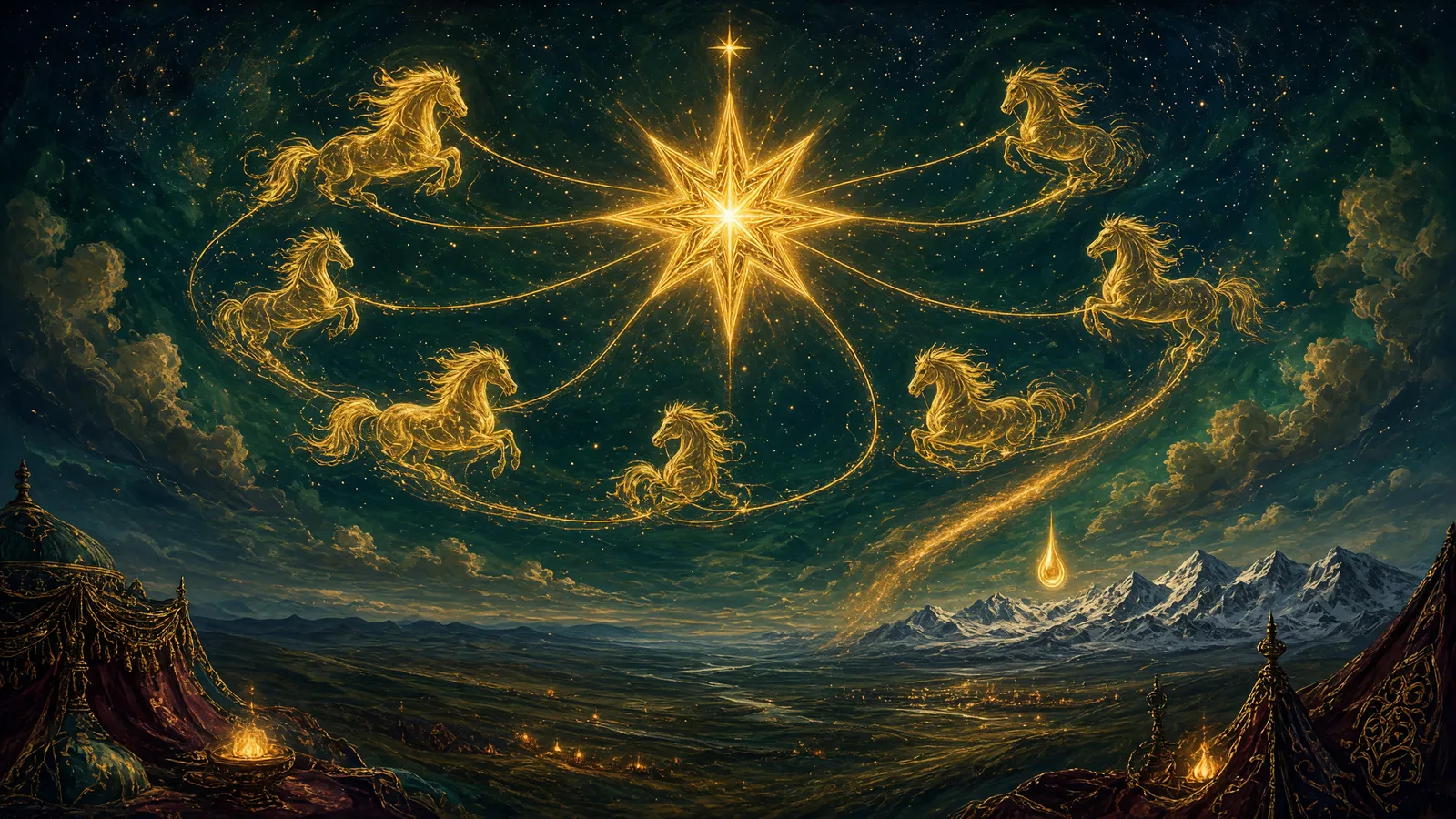
Ülgen had done his work well, but he did not wish to leave it alone. He tethered seven white horses that grazed the heavens to the stake with golden ropes. Every night the horses circled the stake; toward morning they tired and paled, and the next evening they shone again. People called them the Seven Khans. When a child looked up at the sky and asked, "Why do those horses always turn in the same place?", the grandmother would smile and answer:
"Because the place they are tied to is home, my lamb. Home is where a person comes back to, after all the wandering."
The years the hearths began to go out
For a long time, life flowed sweetly beneath the Iron Stake. When evening came the hearths were lit in the camps, the tent flaps were opened, and people went as guests to one another's fires. One cauldron of soup was enough for seven households, one tale was divided across seven nights, one folk song was sung from seven mouths. No one ate alone; to eat alone was thought shameful. If a traveler came to the door, the first thing asked of him was not his name but whether his belly was full.
But deep beneath the earth, where light never descends, sat Erlik Khan. Erlik had been born at the same moment as Ülgen, from the same breath. As Ülgen had taken the light, so Erlik had taken the dark, and what the dark loves best is silence. Each time he heard laughter rising from the camps, Erlik ground his teeth, and the crackle of the hearths pierced his ears like nails. One day he said to himself:
"If I part people from one another, the hearths will go out. If the hearths go out, the laughter will stop. If the laughter stops, half the world will be mine."
Erlik did not come with the sword, for the sword brings people together; against an enemy they stand shoulder to shoulder. He came with something far more cunning: the greed to win. Night after night he crept into the camps and whispered into the ears of the sleepers:
"Your neighbor's cauldron is bigger than yours. Why should you share your soup with him? Let him sit by his own fire and mind his own troubles. Let the gold be yours, the herd be yours, and your door be shut. A shut door is a purse no other hand can reach into."
The whisper did its work slowly. First one household shut its door. Then another. Then people began to look at each other's plates at the table, to count who ate how much. Games, which had once been played for the sake of laughter, came to be played to win something. The winner turned his back and walked away; the loser never sat at the table again. The evenings grew long. Tales were left half-told. Folk songs came to be sung by a single mouth, and a song sung by a single mouth is only a lament.
The tear
One winter night the Iron Stake looked down. What it saw weighed on it more than the horses that had circled it for years, more than the iron it was forged from: there were thousands of tents, but each sat in its own darkness. The fires were burning, but at each fire sat a single soul. Never had the steppe been so crowded, and never so lonely.
The old ones say that stars do not weep. This is true; stars weep very rarely. But that night one of the eight points of the Iron Stake trembled, a drop broke from its light, and it fell, slowly, like a feather, then like a stone, then like a comet. It left a golden line across the darkness of the sky. The Seven Khans grew restless and neighed. Far away, in the forests of Ötüken, a sleeping wolf raised its head and howled.
The drop fell into the snowy mountains of the north, into a pass no road had ever crossed. It sank into the snow and there it waited. It was cold, yet it did not freeze. It was dark, yet it did not go out. Within it slept four colors: the red of fire, the blue of water, the black of earth and the yellow of the sun. For when the Iron Stake had looked upon the world, these were the four things it had seen: the fire people kindled, the water they drank, the earth they walked on and the sun they waited for. These were the same in every corner of the world. People who shared four colors, the star had thought, could surely share a table too.
Deep beneath the earth Erlik saw this light, and for the first time he felt something like fear. He sensed that a fragment fallen from the center of the sky would undo his work, though he did not yet know how. He sent out his shadows, his crows, his black winds to the four corners of the world. To all of them he gave the same command:
"Find the stone. Whoever finds it, bring it to me. Whoever cannot find it, let no one else find it either."
At the other end of the sky, Umay Ana, Mother Umay, protector of hearths and travelers, had seen the light as well. She commanded nothing. She only took the form of a white swan, flew north, and waited. For Umay Ana knew: some things are found not by strength but by loneliness. The stone could be found only by someone who knew, to the very depths, what loneliness was. And that person must choose to use it not for themselves, but for everyone.
Years passed. Snow fell, melted, and fell again. The stone waited.
This book is the story of the young man who found it, the sage who carved it, the khan who tried to steal it, and the tables that were born of it. It is the story of how a palace whose doors never close was built in the north. And if one evening you have sat down at a table and found a smiling face across from you, it is a little bit your story, too.
Refill your tea. The story is long.