
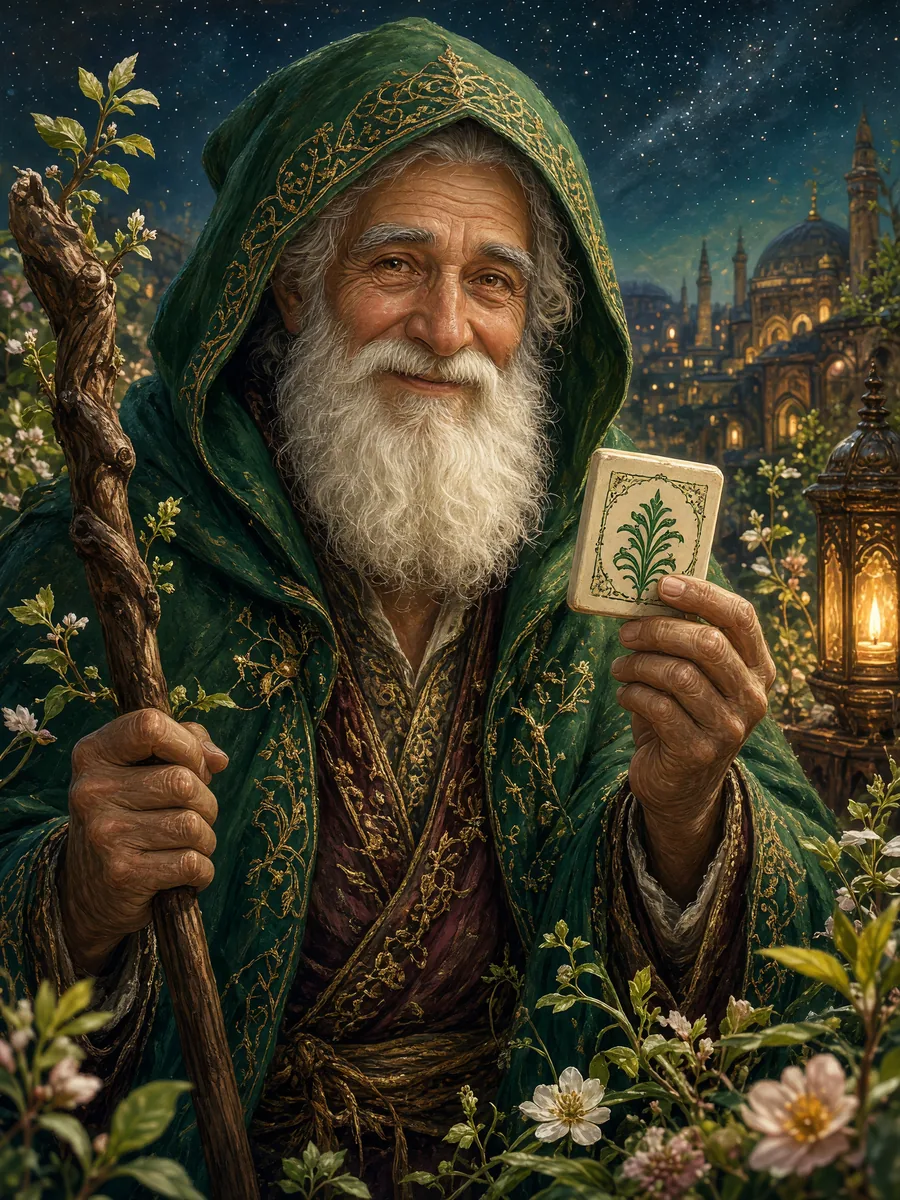
The traveler who comes to those in need, who passes from guise to guise and brings the spring. The two false okeys are his gift; the tile that completes what is missing at the table is his tile.
- Guise
- An old traveler; most often unrecognized
- Emblem
- A green cloak; a white flower blooming in midwinter
- Gift
- Two false okeys bearing a green mark
- Riddle
- "There is a stone that can be any stone."
- In the palace
- The empty chair at every table
- Mythic origin
- In Anatolian and Turkic folk belief, the one who comes to those in need; a symbol of plenty and of spring
He who shares his bread before he eats shortens his road, my son.
In folk belief
In Anatolia and across the Turkic world, Hızır is known as an undying traveler who comes to the aid of those in need and brings plenty and abundance. He passes from guise to guise, most often appearing as a beggar or an old wayfarer; no one recognizes him. Spring begins with his coming; the night of Hıdırellez bears his name. Wherever he passes, dry branches turn green and flowers bloom.
In the story
Aybars meets him beneath a mulberry tree where four roads cross. Hungry as he is himself, he holds out the larger part of his last bread to the old man. In return he receives not bread, but a riddle:
There is a stone that can be any stone.
It fills the place of whatever is missing, yet yields its own place to no one.
By morning the old man is gone; all he leaves behind is the print of a cloak in the flattened grass and a white flower blooming in the dead of winter.
The answer to the riddle comes forty nights later, when two extra green tiles emerge from within the stone. The mark upon them is the same as the print of the cloak upon the grass. In that moment Sina Hoca recognizes Hızır and lays down the meaning of the okey: the indicator is turned up, the tile one above the indicator can be any tile, and the two false okeys stand in its place. Hızır is always one step ahead.
On the night the first table is set, there is a knock at the door; no one is there, only a white flower on the threshold. From that day on, an empty chair is set at every table.
In the palace
Erlik steals his tiles, but when they are played for money the tiles turn blank; once they touch the walnut table, the scent of tea and the crowd of friends, their marks return. On the morning the Black Winter ends, every tree in the village blossoms in midwinter, and at the edge of the square an old man in a green cloak is playing okey.
Today, if at an okey table you see the missing tile arrive at the very last moment from an unexpected hand, or if four people laugh at the same thing at the same moment when a hand ends, the people of the palace all say the same thing: Hızır was at the table.