
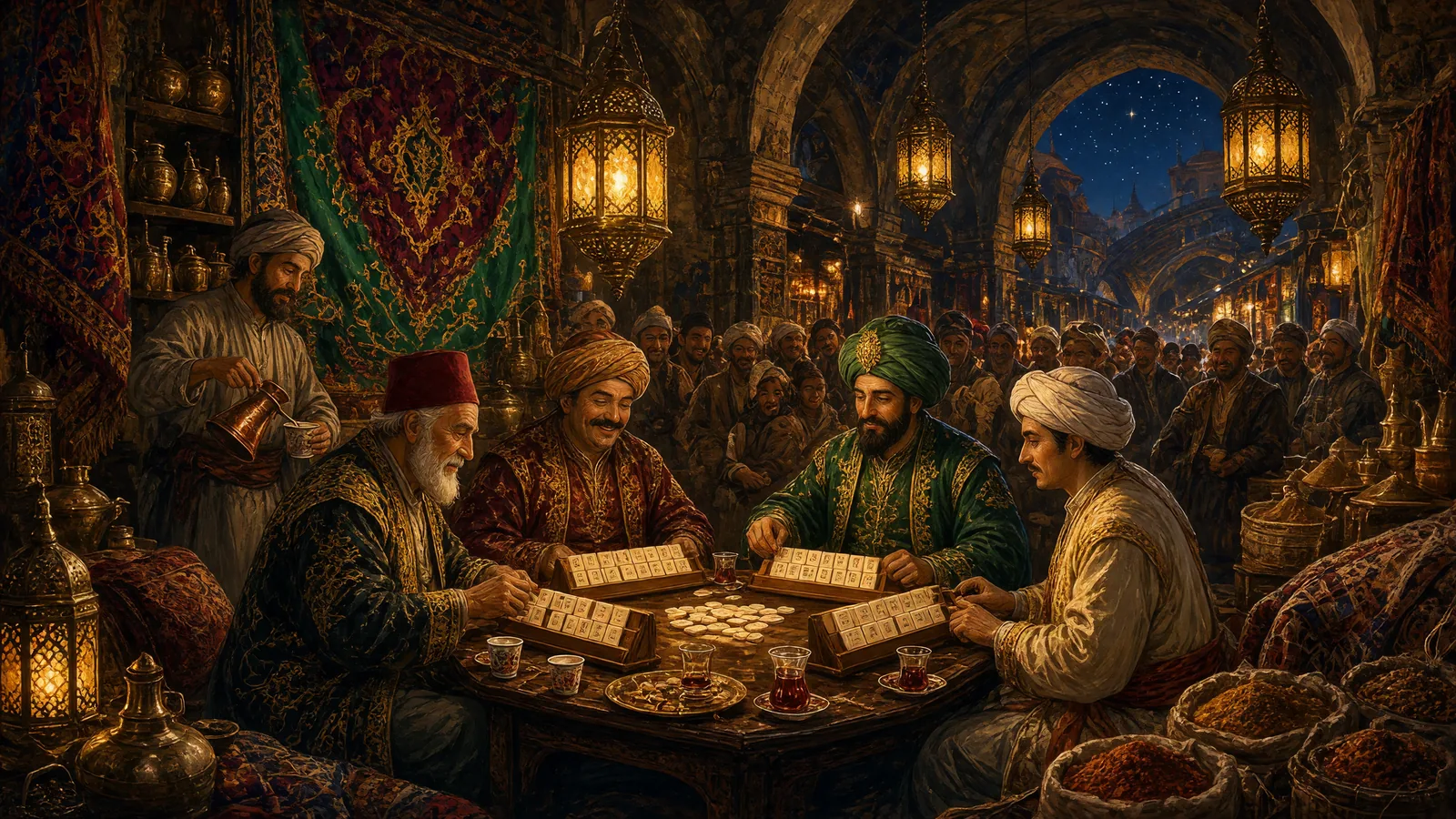
The Grand Bazaar — the Kapalıçarşı, the covered market — was a city inside a city. Sixty streets, thousands of shops, hundreds of hans, dozens of fountains and cats beyond counting. Its ceilings were vaulted, its walls gilded, its air heavy with cinnamon, leather, attar of roses and coffee. By day the crowds were so thick you could hardly walk; by night, when the gates were shut, the whole place sank, with its own watchmen and its own cats, into a long sleep.
But that winter, something was stirring in the Bazaar's sleep.
Aybars learned of it near dawn, in the narrowest lane of the market, as a coffee-keeper was raising his shutter. The coffee-keeper was a round-bellied, smiling man with a thick black mustache and a red fez. He was not afraid when he saw Asena; on the contrary, he held out a piece of simit to her.
"A wolf, is it? Mashallah, what a handsome wolf. Come, sit down, young man. Coffee or tea? At this hour coffee does you good — anyone can see you haven't slept."
This was Kahveci Mustafa — Mustafa the coffee-keeper — the oldest coffee-keeper in the Bazaar. His father had kept coffee before him, and his grandfather too. His shop was tiny: three tables, one stove, one shelf full of cups. Yet everything that happened in the Bazaar found its way, sooner or later, to Mustafa's tables. Who had borrowed from whom, who had fallen out with whom, who had married, who had died. Mustafa heard everything, spread nothing, but if you asked, he would tell.
Aybars asked.
The House of the Golden Dice
"Two stones with a green mark?" Mustafa lifted the cezve from the fire and frowned. "I haven't seen them. But strange things have been happening in the Bazaar this past month, that much I'll tell you."
He poured the coffee into the cup. Its foam was exactly right.
"Down at the bottom of the Bazaar, in the cellar of the old Furriers' Han, a place has opened. They call it the House of the Golden Dice. Nobody knows who opened it. Its master is a man dressed all in black, with a voice like a raven's. Everyone calls him Kara Kuzgun — the Black Raven. Inside they throw dice, they play cards, and all of it for money. Those who go in at evening come out at morning. A few come out rich. Most come out without a copper to their name."
Mustafa sighed.
"Do you know Rıza Bey? The biggest shop in the Carpet Sellers' Market was his. Thirty years a tradesman. One evening last month, out of curiosity, he went into the House of the Golden Dice. A week later his shop belonged to Kara Kuzgun. And now..." The coffee-keeper nodded toward the corner.
In the corner, at the very last table, sat a man with his back to the wall. Forty-five, perhaps fifty, with a bushy mustache and a kaftan that had once been costly but was now all creases. The tea before him had gone cold. His eyes were looking at nothing.
"For a week now he's come here every morning, ordered a tea and not drunk it. He doesn't pay, and I don't ask him to. He speaks to no one. He doesn't go home either; he's ashamed."
Aybars looked at the man and recognized something in him. A man sitting alone at the end of a hall with forty chairs.
He rose, went to Rıza Bey's table and sat down across from him.
"Good morning, Rıza Bey. I am Aybars. I have come from the north. I owe you a game of okey."
Rıza Bey
At first Rıza Bey said nothing. Then, slowly, as though he had forgotten the sound of his own voice, he spoke.
"What okey, son? I have nothing left to play with."
"Okey isn't played with money," said Aybars. "It's played with conversation. Have you any conversation left?"
Rıza Bey laughed. A bitter laugh. But he laughed.
And then he told it all. The House of the Golden Dice. How much he had won the first night, how glad he had been, how he had gone home and not told his wife, because he thought, "Tomorrow I'll win even more, and then I'll surprise her." How he had lost the second night. How on the third night he had played bigger, to win back what he had lost. How on the fourth night he had laid the deed to his shop upon the table.
"But the strangest thing," said Rıza Bey, lowering his voice, "happened on the last night. Kara Kuzgun put two stones on the table. Ivory, with a green mark on them. 'These are magic stones,' he said. 'Whoever plays with them wins.' Every eye in the house was on those stones. The Raven threw them like dice." Rıza Bey shook his head. "The stones came up blank. Both of them. No number on them, no mark. White as snow. The Raven threw them again. Blank again. He flew into a rage, struck the stones against the table — nothing. Everyone laughed. The Raven pocketed the stones and fled into the back."
Aybars's heart beat faster.
"Hızır's stones," he whispered. "When they are played for money, they stay blank."
"What did you say?"
"Nothing." Aybars took Rıza Bey's hand. "Rıza Bey, I must get those stones back. And your shop too. But I cannot do it alone."
Mehmet Paşa
That morning a third man came into Kahveci Mustafa's shop. Tall, green-turbaned, gray-bearded, with a heavy gaze. Mehmet Paşa, who answered for the peace of the Bazaar and of the city. He stopped here every morning for a coffee; he cared for no coffee but Mustafa's.
The Paşa listened to Aybars. He listened to Rıza Bey. His brows drew together.
"I know the House of the Golden Dice," he said. "Complaints have been coming in for a month. I have raided it three times. All three times the place was empty. No tables, no dice, no Raven. Nothing in the cellar but cobwebs. And the next night it opens again." He set his cup down on its saucer. "This is no ordinary gaming den, young man. This is something else."
"I know," said Aybars. "This is Erlik's door."
Mehmet Paşa looked at him for a long while. A pasha might well have laughed at a young stranger talking about the khan of the underworld. But Mehmet Paşa did not laugh. For he had noticed that Asena was a wolf, asleep at the young man's feet. And a wolf sleeps only at the feet of one who tells the truth.
"What would you have us do?"
The Plan
Aybars laid out his plan that same morning, in Mustafa's little coffee shop, the four of them bent over one table. Mehmet Paşa objected at first. "It would be simpler to storm it with soldiers," he said. Aybars shook his head.
"You stormed it three times, my Paşa. It was empty. Erlik's house is not emptied by the sword. Because that house does not feed on swords. It feeds on loneliness. Why do people go there? For money? Not only that. Because they have nowhere else to go of an evening. Because no one is waiting for them at home. In the House of the Golden Dice there is at least a crowd, a noise, a thrill. Erlik knows this."
"And so?"
"And so we will make a crowd of our own. But a crowd in which no one loses. Right across from the House of the Golden Dice. One table. Then two. Then ten. Open to everyone. Asking no one for money. The tea is free, the talk is free. And so is the game."
Mustafa twirled his mustache. "And who's going to brew the tea?"
"You," said Aybars, smiling. "The finest tea in the world. I'll bear the cost. The whole revenue of my lordship in the north will cover it."
Rıza Bey raised his head. "I'll find the tables," he said. For the first time in a week, his voice was alive. "There are still thirty merchants in the Bazaar who owe me money. Not one of them has paid. Let them give tables instead, and we'll call it square."
Mehmet Paşa was silent for a while. Then he stood.
"And I will have the courtyard of the Furriers' Han cleared. Whoever sets up a coffee stove there tomorrow evening will be under the protection of the state."
Tables in the Courtyard
The next evening ten tables were set out in the courtyard of the Furriers' Han. Walnut tables from Rıza Bey's debtors, samovars carried over from Mustafa's stove, ten okey sets from Sina Hoca's shadow sets. Hasan Efendi lettered a sign and hung it on the gate:
Kahvehane. Here no one loses.
The first evening only a few curious souls came. Those going down and coming up through the door of the House of the Golden Dice in the cellar threw sidelong glances at the tables in the courtyard and went on their way. But the smell of Mustafa's tea drifted all the way down into the cellar. And so did the sound of ivory stones being shuffled on walnut.
The second evening a man came out of the House of the Golden Dice, pockets empty, head bowed, and stopped as he crossed the courtyard. At one of the tables a seat was empty. Rıza Bey saw him and called out:
"Come, brother. We're looking for a fourth."
The man was ashamed at first. "I have no money," he said.
"Money doesn't pass hands here," said Rıza Bey. "A week ago I was just like you. Sit down."
The man sat. Mustafa set a tea before him. The stones were dealt. And an hour later, that man who had come out of the House of the Golden Dice without a copper to his name laughed aloud in the courtyard, cried "Okey!" and laid down his hand. The table applauded. No one had won anything. But that night, going home, the man had his wife open the door for him, and he told her about the whole evening.
On the third evening there were twenty tables in the courtyard. On the fourth, forty. The stairs down to the cellar fell empty. At the door of the House of the Golden Dice stood Kara Kuzgun in his black garments, trembling with rage. One by one, the tables inside his house were emptying. The dice gathered dust, for no one threw them. And that house which fed on the underworld, finding no loneliness to feed on, began to shrink.
Kara Kuzgun
On the fifth evening, Kara Kuzgun came up into the courtyard.
He passed between the tables. Everyone fell silent. Mehmet Paşa reached for his sword, but Aybars stopped him. The Raven halted in the middle of the courtyard, before the table where Aybars sat.
"You have killed my house," he said. His voice truly was like a raven's croak.
"No one killed your house," said Aybars. "People simply didn't want to come. When no one wants to come to a place, that place dies of itself."
For an instant the Raven's eyes, like Erlik's eyes, glowed like embers. He reached into his kaftan and drew out two stones. Ivory, pure white, with neither number nor mark upon them.
"Is this what you want? Take them. They're useless anyway. However many times I threw them, they came up blank."
He flung the stones onto the table.
And the moment the stones touched the table — the moment they felt the warmth of the walnut wood, the smell of the tea, the murmur of the forty tables all around — the green mark appeared again. First like a faint shadow, then like a leaf, then shining like a fresh green shoot.
The courtyard fell silent. Everyone stared at the stones.
Kara Kuzgun took a step back. For the first time his face wore something close to fear. "How...?"
Aybars picked up the stones.
"Hızır's stones stay blank when they are played for money," he said. "Because their work is not to make anyone win, but to complete. To complete what is missing at a table. There was no table in the House of the Golden Dice, Kuzgun. There were only people, each with his own purse, side by side but alone. There was nothing to complete."
Kara Kuzgun said nothing. He swept his kaftan about him as though taking wing and melted into the shadows of the courtyard. A crash came from the cellar, something collapsed, then silence. The next morning, when Mehmet Paşa's soldiers went down into the cellar, they found nothing there. No tables, no dice, no door. Only a damp wall, and at the foot of the wall, the deed to Rıza Bey's shop.
The First Kahvehane
That winter the courtyard of the Furriers' Han never closed. Kahveci Mustafa moved his stove there. The tables stayed. The sign stayed. People came every evening, sat down, drank tea, played okey. The old taught the young, and the young found new sayings for the old. Shopkeepers who haggled with one another all day long passed each other the okey at the same table in the evening.
People gave that place a name: Kahvehane. The coffeehouse. In the palace of the north today, the warmest and most crowded hall, the one where newcomers sit first, takes its name from there.
Rıza Bey went back to his shop. But every evening he stopped by the Kahvehane, and to every stranger hovering at the door, too shy to come in, he said the same thing: "Come, brother. We're looking for a fourth." In time he would become the first host of the Grand Bazaar hall in the palace of the north.
As for Mehmet Paşa, he still came every morning for his coffee, but now he stopped by in the evenings too. And one day he said to Aybars:
"For thirty years keeping the peace has been my trade. With the sword, the dungeon, the penalty. The greatest quarrel in this city was settled by a table." He shook his head. "If one day I come to your palace, give me a seat in the Divan. I'll leave my sword at the door."
And when Aybars returned Hızır's two stones to the master set in Sina Hoca's attic, the hundred and six stones were whole once more. That night at the table sat Sina Hoca, Hasan Efendi, Fatma Nine and Aybars. Beside the empty chair in the corner another chair was added: for Rıza Bey. And another: for Mehmet Paşa. And another: for Mustafa.
The room filled with chairs. Aybars paused to look, and smiled. In Kara Toğrul's hall there had been forty chairs as well. But every one of these chairs had someone to sit in it.