
The letter came on a winter morning. But this winter was not the mild, rain-soft winter of Konstantiniyye. The courier who brought it stood shivering at the door, his beard white with rime, the edges of the paper crusted with crystals of ice. He handed the letter to Hasan Efendi and said only one thing: "From the north. Forty days on the road. Three of my horses froze along the way."
The letter was from the steward of Aybars's lands. It was written in a trembling hand, plainly by fingers numb with cold:
Son of the bey,
Since you left I have kept your word. Every evening I called one of the villagers to the table in the hall. The chairs had begun to fill. Then the winter came. This winter is different. The snow falls black. There is a voice inside the wind, and it whispers. The people have shut their doors. No one goes to anyone's house. The hearths do not go out, but they do not warm either. Neighbors no longer know one another. The children do not play. I sit alone in the hall. The forty chairs are empty again.
I remember your father's hall. That silence.
Come back, Aybars. Or do not. I do not know. Perhaps it is already too late.
When Aybars read the letter, his face went white as bone. Sina Hoca took it from his hand, read it, and then clasped his hands together.
"The Black Winter," he said. "Erlik's last weapon. I have read of it in books, but I have never seen it. It rains loneliness down upon a land. Not snow: loneliness. The people do not die. But they do not live, either. They only... forget one another."
"Why my lands?" said Aybars.
"Because the stone came from there," said the Hoca. "And because on the night Erlik lost to Sissa, he understood something: he cannot defeat these tables here, in this city. This place is too crowded, too loud, too alive. But in the north, where the stone was born, if he tears the people apart from one another, he dries up the stone's root. And when the root withers, so do the branches."
Aybars went to the window. He looked at the dome. Then he looked north.
"I am going," he said.
Who would come
Aybars thought he would go alone. But that evening, in Sina Hoca's attic room, there was a gathering.
Nilüfer was the first to speak. "I am coming too." No one objected; they all knew there was no point in objecting to Nilüfer.
Doğan stood behind Nilüfer. He said nothing. He did not need to.
Sina Hoca looked at his books, his astrolabes, the dome. For forty years he had not left this house for longer than a week. "An old man's last journey," he said. "Let it at least be a beautiful one." He took the case of the master set into his lap.
Hasan Efendi began packing his ledgers into a chest. "Wherever the Hoca goes, there go I."
Fatma Nine brought a sapling from the walnut tree, a small shoot that had sprung up from its roots. "I don't know whether walnuts grow in the north," she said. "But we won't know unless we try."
Kahveci Mustafa filled a sack with his cezve and his finest coffee beans. "Is there coffee in the north?" he asked. Aybars said no. Mustafa sighed. "Then I'll have to bring it."
Rıza Bey and Mehmet Paşa could not come; the one could not leave the bazaar, nor the other the city. But Rıza Bey gave them the warmest furs for the road, and Mehmet Paşa the finest horses. "We will come by spring," they said. "Keep the palace door open."
As for Sissa Dede, he was old, very old, and could not have borne the cold of the north. But he held out his chess set to Aybars. "Let these go in my place. And do not forget this: we have beaten Erlik once. Not with the sword. With patience. So it will be this time, too."
The northern road
The journey took forty days. Akyel flew ahead, showing the way. Asena circled the caravan, keeping wolves and bandits at a distance. They crossed the Red Ridges, they passed beside the glacier, they passed beneath the mulberry tree where the four roads meet. In the heart of winter, the tree had blossomed again. Aybars dismounted and left a piece of bread at its foot.
The nearer they came to the north, the more the air changed. First the sky turned gray. Then the snow began. But this snow was not white; it was the color of ash, sooty and heavy. It did not melt when it touched the ground. And inside the wind, just as the steward had written, there was a voice. A whisper. The first time Aybars heard it, he shuddered:
Turn back. No one is waiting for you. Go home, shut your door, be alone. Loneliness is peace. Loneliness is safety. No one can hurt you, no one will ask anything of you.
One by one, the travelers in the caravan fell silent. Mustafa stopped his jokes. Hasan Efendi stopped writing. Fatma Nine pressed her sapling to her breast and closed her eyes. Even Doğan, Doğan who always stood straight as a spear, let his shoulders fall.
Aybars took out Umay's ember. He lit a fire in the middle of the caravan. He called everyone to it. The fire burned, but it stayed small. The wind of the Black Winter was trying to smother it.
Nilüfer took out the cards. "Let's play," she said.
"Here?" said Hasan Efendi. "In this cold?"
"Right here," said Nilüfer. "Right in this cold."
Beside the fire, in the midst of the ash-colored snow, they played Batak. Reluctantly at first. Then, one hand, two hands, one keeping his word and another going under, and a laugh escaped from Mustafa's mouth. Then from Hasan's. Then from Fatma Nine's. And with every laugh, the fire rose a hand's breadth higher. The whisper fell silent.
The caravan went on its way. Every evening a fire, and at every fire a game.
The lands of the bey
When they reached Aybars's lands, the sight that met them froze their hearts.
The village lay under ash-colored snow. Smoke rose from the chimneys, so people were living; but there was no light in any window. There was no one in the streets. Not a child, not a dog, not a bird. The doors were shut. Snow had drifted against some of them, and no one had cleared it away.
Aybars knocked on a door. He waited a long while. The door opened a crack. An old woman looked out, her eyes empty.
"Auntie, it's me, Aybars. Kara Toğrul's son. Do you remember me?"
The woman looked at him. She did not know him. "Go away," she said. "I don't want anyone." She shut the door.
Aybars knocked on a second door. A third. A tenth. At every one, the same. Empty eyes. "Go away." Doors closing.
At last they reached Kara Toğrul's hall. The steward was waiting for them at the door. He had grown thin, he had grown old, but his eyes were still alive. Perhaps his were the only living eyes left.
"You came back," he said.
"I came back," said Aybars, and embraced him.
They went into the hall. Forty chairs. Forty plates. All of them empty. Gathering dust. And at the end of the table, where the steward had eaten alone every evening, a single plate.
Erlik
That night the storm broke.
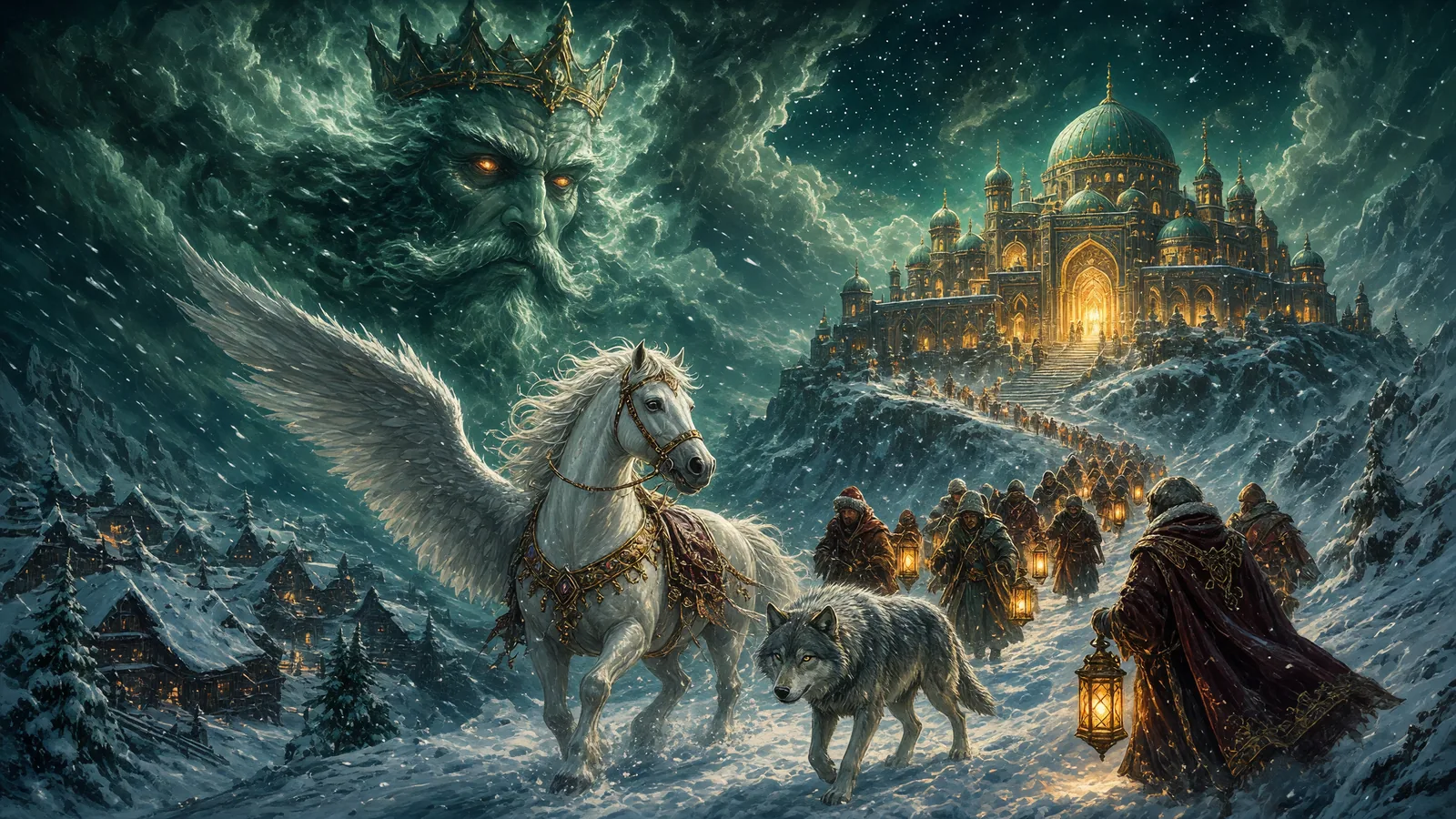
The ash-colored snow began to fly sideways. The wind beat at the windows of the hall. And in the middle of the sky, within the clouds, a face appeared. Enormous. Crowned with iron. Its eyes two embers. Its beard tangled into the storm clouds.
"So you have come."
Erlik's voice echoed through the whole village. In their houses, people stopped their ears.
"You have come, and what have you found, northerner? Your father's village. Your father's hall. Your father's silence. This is my kingdom now. Here everyone is alone. Here no one wants anyone. You set up a table in Konstantiniyye; very well. But here no one will sit at it. Because here everyone is by their own hearth, in their own darkness, happy."
Aybars stepped out through the door of the hall and stood in the snow. He looked up at the face in the sky.
"They are not happy," he said. His voice was lost in the wind, but Erlik heard it. "They are only afraid. Afraid that if they open the door someone will come in, will ask for something, will hurt them. You sold them fear and called it peace."
"And what will you sell them?"
"Nothing," said Aybars. "I do not sell. I invite."
Forty chairs
Aybars went back into the hall. He gathered everyone together.
"We cannot defeat Erlik with the sword," he said. "Nor can we melt Erlik's winter with a lantern. But we have beaten him once: in the Grand Bazaar, with a table. We beat him again: on Sissa's board, with patience. This time we will do the same."
They cleared the forty chairs of their dust. Mustafa lit the stove, and the smell of coffee spread through the hall. Fatma Nine went into the kitchen and began cooking soup for forty. Hasan Efendi set out the forty plates. Sina Hoca opened the master set; the one hundred and six tiles spilled across the walnut table. Nilüfer laid her cards and Sissa's chess set along the edge.
Then Aybars placed Umay's ember in the great hearth of the hall.
"Now," he said. "Let us play. Loudly. With laughter. Shuffle the tiles, slap down the cards, call okey, go under, give checkmate. This village is freezing in its silence. We will give it a voice."
They played.
At first only themselves. Seven travelers, a wolf, a steward. The hearth burning, but small. The wind beating at the windows. The clatter of tiles filling the hall. Mustafa's laughter, Nilüfer's cry of "Spades Trump!", Hasan Efendi's joy: "One hundred and one! I've passed one hundred and one!"
And then Aybars turned to Asena.
"My companion," he said. "Go down into the village. Go to every door. Howl. Force no one. Only howl."
Asena went. He turned to Akyel.
"You too. Rise into the sky. Circle above the village. Let them hear the sound of your wings."
Akyel went.
The first guest
An hour passed. No one came.
Two hours passed. No one came. The wind grew fiercer still. Erlik's laughter came down from the sky.
At the end of the third hour, the door of the hall creaked.
In the doorway stood the old woman from the very first door Aybars had knocked on. She was smeared with ash-colored snow, and she was trembling. Her eyes were still empty. But there was a lantern in her hand; she had heard Asena's howl, left her house, and walked all this way through the snow by the light of her lantern.
"I heard a sound," she said. "The sound of tiles. When I was a child... my mother... used to play with tiles..."
Fatma Nine rose from her seat, went to the woman, threw her own fur around her shoulders, and led her by the hand to the table. She pulled out a chair. She sat the woman down. She set a bowl of soup before her.
"Welcome," she said. "It's your turn."
The hearth rose a hand's breadth higher.
The fortieth guest
Then the second came. A child. Then the child's father, who had gone out searching for his son. Then a blacksmith. Then a shepherd. Then a widow and her two daughters. Then an old man and his grandson. Each of them had heard Asena's howl or the beat of Akyel's wings, had drawn back their curtains, had seen the light spilling from the windows of the hall, and, without knowing why, had lit their own lantern and come out.
Each one who came sat down in a chair. With each one who sat, the hearth grew. As the hearth grew, the walls of the hall grew warm, the ice on the windows melted, the light spilling from the hall spread over the village, and in that spreading light another window opened.
By midnight there were forty people in the hall. All forty chairs were full.
And still there were people waiting at the door.
For a moment Aybars stood frozen. All forty chairs were full. In his father's hall, for the first time since his father's death, every chair was full. And it was not enough.
"Join the tables together," said Nilüfer. "Open the door. Carry them into the courtyard. Into the village square."
And so they did.
The square
As dawn broke, there were hundreds of people in the village square. The tables had spilled from the courtyard into the street, from the street into the square. At the head of every table a fire, around every fire four people. The click of okey tiles, the rustle of cards, the tick-tock of the chess clocks. Mustafa's coffee had run out, and the village women had brewed their own tea and brought it. Fatma Nine's soup was long gone, and the village baker had lit his oven and was handing out bread.
And the face in the sky began to fade.
Erlik's ember eyes flickered. His iron crown gathered rust. His beard, the storm clouds, began to scatter. The ash-colored snow fell no longer. And the snow on the ground, beneath all those feet, was slowly turning white.
"No," said Erlik. But his voice was no longer thunder; it was like a distant wind.
Aybars walked out into the middle of the square. Into the midst of all the tables, beside the one empty chair. The empty chair that Fatma Nine had set at every table since the very first table in Konstantiniyye. The guest's chair.
Aybars looked up at the sky and called out to Erlik:
"Come, Erlik Khan. Sit. Let us play a hand."
The square fell silent.
The face in the sky looked down at Aybars. For a long, long time. Something stirred in the ember eyes. Perhaps anger. Perhaps astonishment. Perhaps, very deep down, a crack in a loneliness thousands of years old.
"You... invite me to the table?"
"There is room for everyone," said Aybars. "I gave my word to Şahmeran. I give it to you, too."
A moment. Only a moment. The face in the sky seemed about to descend. The clouds bent down toward the square. An ash-colored mist drifted toward the empty chair.
But then it stopped.
"I cannot," said Erlik. His voice had broken. "I... do not know how to be a guest. I never have been. To sit at a table, to have someone pour me tea, to wait my turn... I do not know how. I know how to take. Not how to give."
"You will learn," said Aybars.
"Perhaps," said Erlik. "One day."
And the face in the sky came apart. The clouds opened. And in the middle of the sky, directly above their heads, the Iron Stake shone brighter than ever, blazing with all eight of its points. The Seven Khans wheeled around it as if dancing at a festival.
The sun rose. The snow, white and glittering, was melting in the sunlight.
Spring
At the edge of the square, in a corner no one noticed, an old man in a green cloak sat with a glass of tea before him. The players at his table discarded to him, and he discarded back to them. No one asked who he was. It did not occur to anyone.
But that morning, the morning the Black Winter ended, every tree in the village burst into blossom at once. In the middle of winter. Snow-white blossoms.
And the walnut sapling Fatma Nine had brought, on the day it was planted in the courtyard of Kara Toğrul's hall, put out its first leaf.
Aybars stood on the threshold of the hall and looked out over the square. Tables, fires, people. Nilüfer came to his side and took his hand.
"My father gathered silence for a whole lifetime," said Aybars.
"And what will you gather?" asked Nilüfer.
Aybars looked at the square, at the laughter, at the sound of the tiles.
"This," he said.